
HCM CITY — Businesses need to rethink how work is organised and how employees collaborate with artificial intelligence (AI) to translate technological advances into productivity gains and lasting business value, speakers at The Makeover 2026 conference said.
Data from Marsh presented at the conference showed that 91 per cent of organisations planned to increase investment in AI in 2026, but only 12 per cent of chief executives said AI had delivered both cost savings and revenue growth. The challenge lies not in the technology itself, but in how work, decisions and people are organised around it.
Held under the theme “RE.verse: Your Actions in a Shifting Multi-verse”, Talentnet’s annual conference brought together more than 15 international and regional speakers, business leaders and C-suite executives to discuss human-centric management and strategies for navigating economic, technological and geopolitical uncertainty.
Lewis Garrad, Asia workforce and rewards regional leader at Marsh, said AI was reshaping organisational structures and workforce strategies, creating new demands for skills development, resource allocation and work design.
While AI enables employees to complete tasks faster and produce more output, this does not necessarily translate into greater business value if workflows and decision-making processes remain unchanged.
“AI is not enough. Organisations must redesign work around human-centric principles, fostering cultures of dynamic human-machine collaboration and continuous upskilling and reskilling of talent,” Garrad said.
Rather than focusing solely on cutting jobs, businesses should break roles down into individual tasks, identify where technology could add value and determine the most effective combination of human capabilities and machines.
Hybrid jobs reshape talent demand
AI is accelerating the emergence of hybrid jobs that combine two distinct areas of expertise, such as information technology and marketing in digital marketing roles. However, educational institutions are struggling to develop these skills quickly enough to meet changing business needs.
Garrad also highlighted concerns about AI’s impact on employment, citing research showing that 40 per cent of employees feared AI could replace them, while 60 per cent believed leaders did not adequately understand its psychological and social effects.
Leaders must therefore communicate clearly about transformation, develop workforce capabilities and foster an adaptive culture. People remain central to an organisation’s ability to respond to uncertainty, even as AI reshapes its operations.
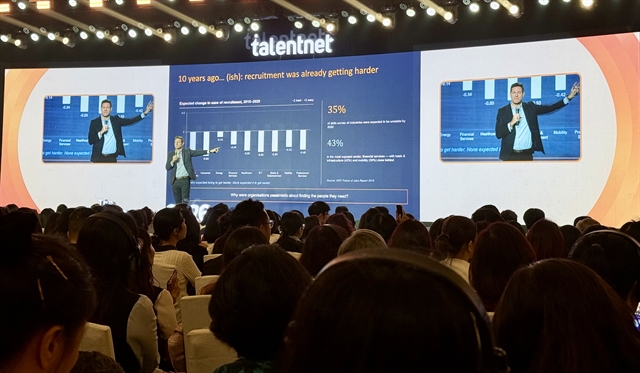 |
| Lewis Garrad, Asia workforce and rewards regional leader at Marsh, speaks about leadership during the AI-driven transformation of the workplace at the conference. — VNS Photo |
Speakers also discussed which innovation initiatives businesses should pursue or discontinue, which values they should preserve as they grow, and how to maintain momentum as AI accelerates change. They explored ways to identify declining creativity, rebuild trust and strengthen team alignment before these issues undermine business strategy.
The conference also explored Việt Nam’s economic outlook and its implications for business strategy.
Michael Kokalari, chief economist at VinaCapital, said Việt Nam was well positioned for substantial economic growth over the next five years, supported by industrialisation, favourable demographics and its role as a trade connector amid global political divisions.
He identified infrastructure investment, rising middle-class consumption and potential increases in foreign investment as key growth drivers. The country’s strong foundations in mathematics and engineering could also support advances in AI and technological capabilities.
Kokalari encouraged domestic businesses to modernise their operations and adopt more professional management and human resources practices to capitalise on these opportunities.
Nguyễn Thị Quỳnh Phương, head of human capital solutions at Talentnet, presented findings from the Talentnet-Mercer Total Remuneration Survey 2026, which provides an overview of Việt Nam’s labour market and encourages employers to adopt flexible reward strategies that create value for both employees and organisations.
Tiêu Yến Trinh, founder and CEO of Talentnet, said leaders faced the challenge of navigating multiple forms of disruption simultaneously.
“The greatest challenge facing leaders today is not that the world is changing, but that too many worlds are changing at once. We cannot control every disruption, but we can choose how we act,” she said.
“As Việt Nam pursues its ambitious development goals, every business has an opportunity to help write a new future. We cannot write the story of the entire world, but we can certainly write the next chapter of our own.”
Under the conference’s RE.verse framework, Trinh encouraged leaders to respond agilely to emerging trends, rethink established approaches to create new value and remain committed to human values amid constant change. — VNS