
 |
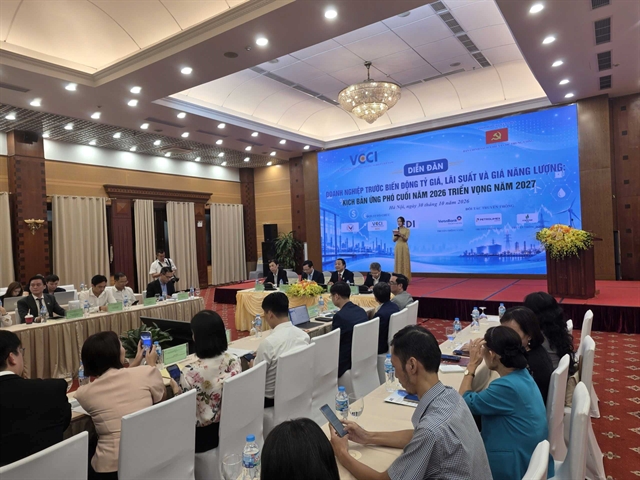
| A forum titled businesses amid exchange rate, interest rate and energy price volatility was held in Hà Nội on October 30. — VNS Photo Hoàng Hà |
HÀ NỘI — Exchange rate, interest rate and energy price volatility is putting mounting pressure on businesses’ production costs, cash flows and competitiveness, highlighting the need to diversify funding sources, and strengthen financial management to maintain operations and build resilience.
The Vietnam Chamber of Commerce and Industry (VCCI), in coordination with the Central Policy and Strategy Commission, held a forum titled businesses amid exchange rate, interest rate and energy price volatility in Hà Nội on October 30.
The event brought together representatives from the State Bank of Vietnam, financial institutions, economic experts, industry associations and more than 100 delegates to assess macroeconomic risks that could directly affect business and production activities in late 2026 and 2027.
In his opening remarks, VCCI Vice Chairman Nguyễn Quang Vinh said businesses were facing dual pressure: completing their 2026 production and business plans while preparing development strategies for 2027 amid an increasingly unpredictable global economic environment.
Exchange rates, interest rates and energy prices are not merely macroeconomic indicators but factors that directly affect individual contracts, orders and investment decisions, he said.
Exchange rate fluctuations can increase the cost of imported materials and machinery, as well as foreign currency debt-servicing obligations. Interest rates affect borrowing costs, while energy prices influence operating and transport expenses and the competitiveness of products.
These factors can compound one another, placing greater pressure on manufacturers and exporters with high imported-input costs or heavy reliance on borrowed capital.
Assessing the global and Vietnamese economic outlook for 2026-2027, Associate Professor Bùi Quang Tuấn said Việt Nam’s economy continued to maintain positive growth momentum, but the room for macroeconomic policy manoeuvre was narrowing.
Volatility in energy prices, exchange rates and interest rates, together with the investment cycle in artificial intelligence (AI), could affect exports, foreign direct investment (FDI) inflows and production costs, he said.
To achieve its double-digit growth target, Việt Nam needs to prioritise macroeconomic stability, proactively develop response scenarios and promote new growth drivers based on science and technology, innovation, digital transformation and green transition, Tuấn said.
Economic expert Võ Trí Thành warned that challenges to macroeconomic stability were mounting, particularly inflationary pressures, the risk of a trade deficit, exchange rate volatility and imbalances between capital mobilisation and credit growth.
According to figures cited by Thành, the gap between outstanding credit and deposits had at times reached VNĐ2.3 quadrillion, putting pressure on banking system liquidity and interest rates.
Geopolitical instability, energy price volatility and reliance on external capital flows were also increasing risks for an open economy as Việt Nam, he said.
Thành said the challenge was not only to maintain short-term macroeconomic stability but also to improve forecasting capacity and resilience against external shocks.
He proposed establishing an early warning system for macroeconomic variables, flexibly adjusting growth scenarios and accelerating the shift towards sustainable growth drivers such as science and technology, digital transformation and the green economy.
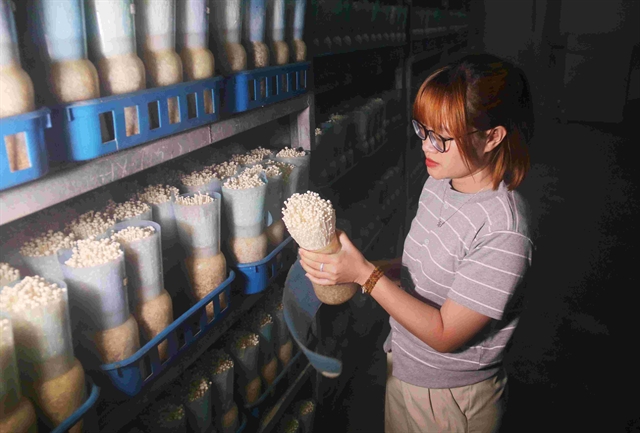 |
| Production of mushrooms in KINOKO Long Khánh Import-Export Co, Ltd in Đồng Nai Province. Businesses need to strengthen management capacity, improve their ability to absorb capital and adapt to changing market conditions. — VNA/VNS Photo |
Need for diversified funding
As macroeconomic risks increase, access to capital and the ability to maintain liquidity are becoming critical issues for businesses in late 2026 and 2027.
Speaking at the forum, Dr Nguyễn Đức Hiển, Deputy Head of the Central Policy and Strategy Commission, stressed the need to maintain macroeconomic stability, control inflation, safeguard major economic balances and mobilise resources for growth.
Businesses need to strengthen management capacity, improve their ability to absorb capital and adapt to changing market conditions, he said.
One major concern raised by experts was businesses’ heavy reliance on bank credit, particularly for medium- and long-term financing.
Although bank lending remains an important source of funding for the economy, the banking system is unlikely to meet the entirety of businesses’ growing investment needs.
This highlights the need to develop capital markets and diversify funding channels to ease pressure on bank credit and establish a more sustainable financial foundation for business operations.
Meanwhile, Đào Văn Hà, Deputy Director of the State Bank of Vietnam’s Department of Forecasting and Statistics, said monetary policy would continue to be managed proactively and flexibly to maintain macroeconomic stability, control inflation and support growth.
Exchange rates would be managed in line with market developments, with interest rate and liquidity tools coordinated alongside foreign exchange intervention when necessary to limit the impact of external shocks, he said.
The banking sector would continue to prioritise credit for production, business activities and growth drivers while controlling lending to sectors carrying potential risks.
Credit institutions have also been required to disclose lending rates, develop suitable credit products and strengthen engagement with the business community.
However, the State Bank representative stressed that resolving businesses’ financing difficulties could not rely solely on the banking system. It required coordinated efforts involving monetary policy, ministries and agencies, and businesses.
To gain access to long-term funding, businesses also need to improve the transparency of financial statements, standardise data, strengthen corporate governance and develop viable capital utilisation plans.
Cash flow management to limit risks
At the forum, Vinh outlined some key priorities for businesses, such as developing multiple scenarios to respond to market volatility; and centralising cash flow management. They should also diversify funding sources and improve access to capital markets; and develop a financial ecosystem.
Businesses should proactively manage currency exposure, loan maturities, inventories and payment terms to mitigate risks arising from exchange rate and interest rate fluctuations, he said.
For businesses in 2027, the challenge will extend beyond forecasting whether exchange rates or interest rates will rise or fall. It will also involve maintaining operations and protecting cash flows under adverse scenarios.
As external factors become increasingly difficult to control, financial management capacity, technological innovation and funding diversification will be important foundations for strengthening the resilience and long-term growth prospects of Vietnamese businesses. — VNS