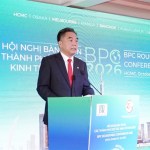
ĐÀ NẴNG — The Vietnam Sustainable Development Forum 2026, themed “Local Strategic Planning: Development – Conservation – Adaptation – Connectivity”, opened on Friday.
The two-day forum focuses on innovative planning approaches, development space organisation and stronger regional connectivity in the new period.
In his opening remarks, Assoc. Prof. Dr. Nguyễn Mạnh Hùng, deputy director of the Ho Chi Minh National Academy of Politics, said the forum’s theme reflects a comprehensive approach to strategic planning based on four requirements. These include development to improve quality of life, conservation to safeguard nature, heritage and community identity, a response to climate change and future uncertainties, and connectivity to help localities maximise their advantages in relations with their regions, the country and the world.
These requirements must be translated into specific planning decisions to ensure rapid growth goes hand in hand with social progress, environmental responsibility and the interests of future generations, he said.
Planning is a key means of translating development orientations into spatial organisation and resource allocation. Its quality reflects leaders’ vision, their understanding of development rules and their ability to address major development challenges. Each decision must therefore be grounded in scientific evidence, legal frameworks, practical conditions, and the long-term interests of the people.
Reforming planning requires a decisive shift from dividing space according to administrative boundaries to organising space around development needs, institutional improvements, stronger implementation accountability and practical participation by residents and businesses, Hùng noted.
Organisers expect experts to propose ways to assess planning through the added value generated per unit of space and resources, and to view climate adaptation as a data-driven learning process, an emerging economic opportunity and a social equity challenge. They will also discuss closer integration of smart transport planning with energy transition and digital technologies, as decisions made today will shape emissions levels for decades to come.
Dr. Nguyễn Đức Hiển, vice chairman of the Party Central Committee’s Commission for Policy and Strategy, said the discussions were particularly timely as Việt Nam implements orientations for organising national, regional and local development space, as well as urban planning, construction and management.
Local planning requires coordination across multiple fields, including architectural space, economic efficiency, ecosystem carrying capacity, technical solutions and financial resources. The challenge lies not only in developing a vision but also in integrating these elements into a coherent and practically feasible whole.
Integrated planning must first mean integrating knowledge before integrating layers of maps, he said, describing the gathering of planners, scientists, local officials and business groups as an important first step towards establishing a common language.
Hiển added that rapid and sustainable development remained a consistent priority in Việt Nam’s development strategies.
Politburo Resolution No. 19-NQ/TW calls for reorganising national development space into a multi-tiered, multi-polar and interconnected structure encompassing land, sea, airspace, underground resources, digital space and emerging development areas. It also advocates shifting from administrative boundary-based development towards approaches based on functions, potential, advantages, natural resources, environmental conditions and regional and sectoral linkages.
Resolution 27-NQ/TW seeks to restructure and efficiently manage regional development space in alignment with national planning, while leveraging each locality’s competitive advantages and cultural identity and strengthening the leading and spillover roles of growth-driving regions, economic corridors and growth poles.
Meanwhile, Resolution 06-NQ/TW, dated January 24, 2022, calls for renewed thinking and methods in urban planning, with long-term, integrated and modern plans placing people and quality of life at the centre, while harmonising urbanisation with industrialisation, modernisation, rural development and economic restructuring. — VNA/VNS