HÀ NỘI — Việt Nam is seeking to turn its northern border provinces into stronger cross-border economic hubs by combining digital border gates, greener logistics and deeper supply-chain links with Laos and China, as changing trade requirements put greater pressure on businesses to improve traceability, sustainability and efficiency.
The direction was highlighted at the 2026 Northern Region Trade Promotion and Import-Export Conference in Điện Biên on September 18, which brought together more than 250 representatives from government agencies, trade promotion organisations, associations and businesses from Việt Nam, Laos and China.
The conference focused on digital transformation and green trade as new drivers of border commerce at a time when regional supply chains are being restructured and exporters face increasingly stringent requirements on product quality, traceability, emissions reduction and circular-economy practices.
Vũ Bá Phú, Director General of the Vietnam Trade Promotion Agency under the Ministry of Industry and Trade, said these changes were reshaping the competitive landscape.
“Digital transformation and green trade are no longer simply trends to choose from but are becoming core competitive capabilities for businesses and individual localities,” Phú said.
Northern Việt Nam plays a major role in the country’s foreign trade. The region recorded more than US$380 billion in import-export turnover in 2025, accounting for around 40 per cent of the national total. Its production base covers electronics, machinery, garments, agriculture and forestry products, handicrafts and other traditional goods.
Border provinces, including Quảng Ninh, Lạng Sơn, Cao Bằng, Lào Cai, Hà Giang and Lai Châu, provide links to southern China, while Điện Biên, Sơn La and northern-central provinces connect Việt Nam with Laos and wider regional trade corridors.
Điện Biên occupies a distinctive position, with more than 455 kilometres of border adjoining both Laos and China. Its border infrastructure includes Tây Trang International Border Gate, Huổi Puốc National Border Gate and Si Pa Phìn auxiliary border gate connecting with Laos, as well as the A Pa Chải–Long Phú crossing with China’s Yunnan Province.
The province is seeking to combine those gateways with logistics, processing and production networks. Planned improvements include the Sơn La–Điện Biên–Tây Trang Border Gate expressway and connecting roads, which are expected to reduce transportation time and costs and support investment in warehousing, logistics, processing and distribution.
Phú said border trade development should move beyond measuring the volume of goods passing through checkpoints.
“If we want border trade to develop sustainably, we cannot focus solely on the flow of goods through border gates but must pay attention to the entire ecosystem behind the border gate,” he said.
That ecosystem encompasses raw-material areas, manufacturing, processing, quality standards, branding, logistics, warehouses, border gates, data, e-commerce and consumer markets.
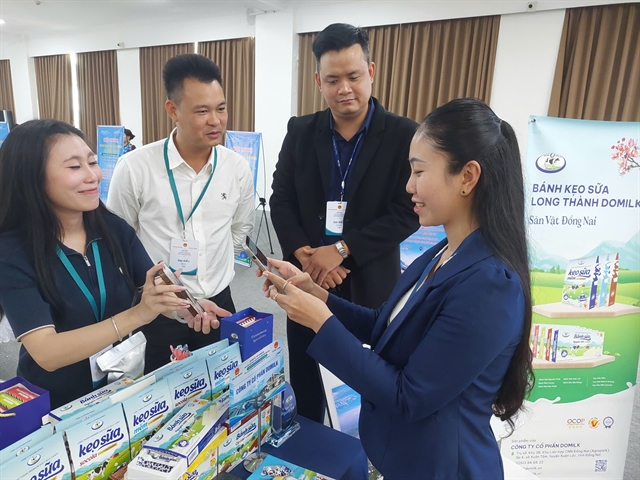 |
| Businesses exchange contacts at the conference. |
Digitalisation is expected to play an increasingly important role. The proposed approach involves developing a digital border-gate ecosystem in which information on vehicles, goods, companies, documentation and customs-clearance procedures can be appropriately connected and shared among relevant authorities.
Cross-border e-commerce, digital trade-promotion platforms, electronic payments, traceability systems and digital supply-chain management are also expected to facilitate trade.
Alongside digitalisation, exporters are being encouraged to move towards higher-value products.
For agricultural products, food, medicinal materials and other goods associated with northern mountainous provinces, this includes better planning of raw-material zones, production unit codes, packing facilities, deeper processing, branding and traceability.
The intended shift is from exports of raw materials and unprocessed products towards processed and branded goods with greater added value.
Green logistics is another focus, with businesses encouraged to adopt cleaner technologies, save energy, reduce waste and develop circular-economy models. In logistics, measures include cleaner energy, optimised transport modes, more efficient warehousing and shorter vehicle waiting times at border gates.
“Green trade must be considered a new competitive advantage, rather than merely a compliance requirement,” Phú said.
He also called for Điện Biên to develop beyond its traditional role as a border province.
“Điện Biên should not simply identify itself as a locality with border gates but should aim to become a locality connecting cross-border flows of trade, services and tourism,” Phú said.
Businesses from the three countries were encouraged to move beyond conventional buyer-seller relationships towards longer-term investment, production and distribution partnerships.
Vietnamese companies could work with Lao partners in raw-material development, energy, agriculture and logistics, while strengthening cooperation with Chinese companies in technology, equipment, processing, logistics and market access.
The Ministry of Industry and Trade said it would continue coordinating with local authorities, trade promotion agencies and industry associations, with business needs and market requirements placed at the centre of future support programmes. — BIZHUB/VNS