
A landmark, highly destructive hurricane is brewing in the southern Gulf of Mexico, and is forecast to become a ferocious Category 3 storm during the next 24 hours.
Threat level: Hurricane Helene will affect all of Florida through Friday. In a rare occurrence, the entire state — with the exception of the far western Panhandle — is under some type of tropical storm or hurricane warning.
- Helene will be an unusually large storm, making a focus on the track of the eye deceiving. (The Hurricane Center notes that Helene is forecast to be in the 90th percentile of storm size at its latitude.)
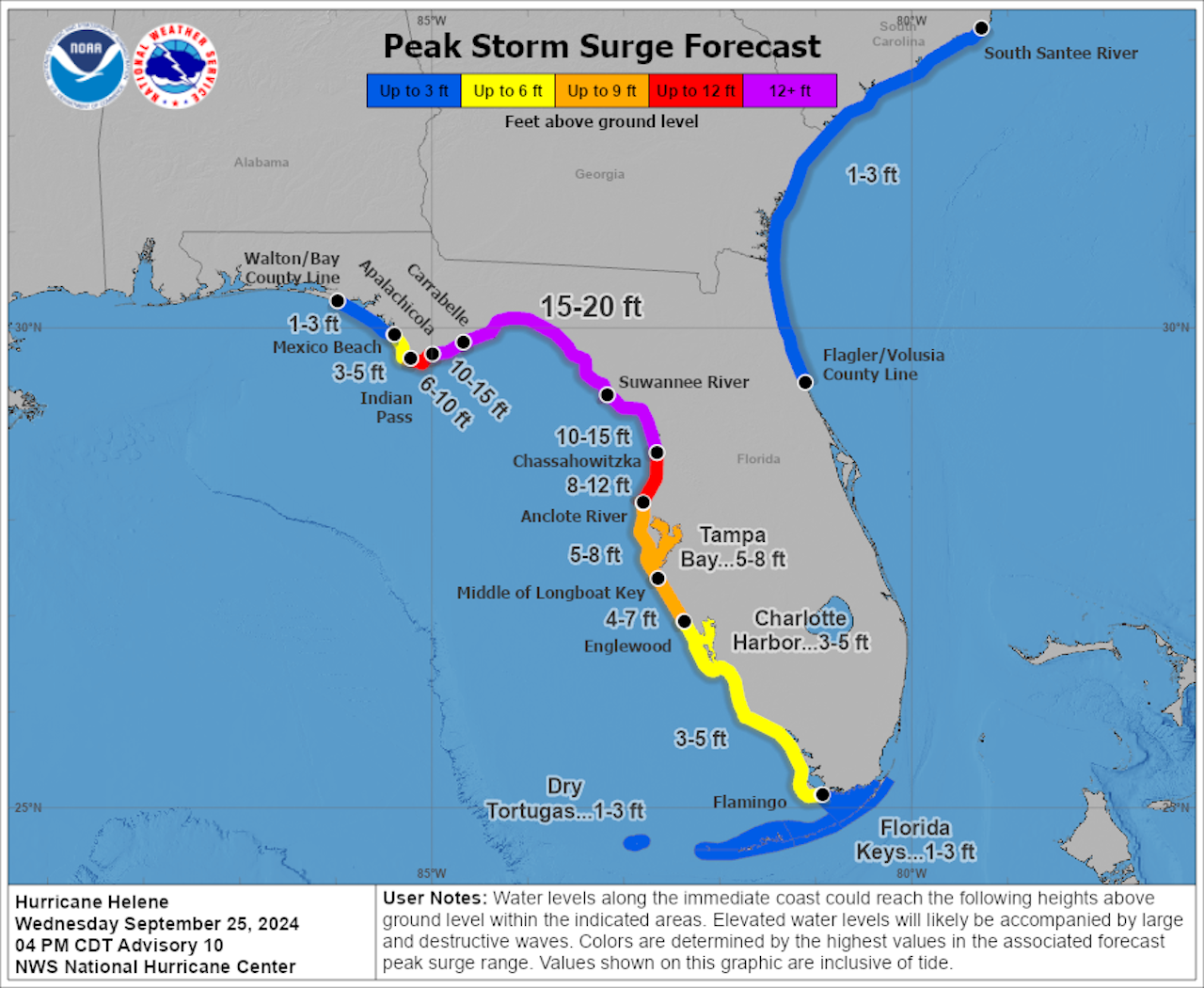
- Florida’s entire west coast is at risk for a damaging storm surge, including Tampa Bay, where a 5- to 8-foot surge is forecast above normally dry land if the storm hits at high tide. This would be one of the city’s biggest surge events on record since data began there in 1947. (More on Tampa Bay’s preparations from Axios Tampa Bay’s live coverage.)
- There were evacuations for low-lying areas along the state’s west coast on Wednesday. Up to 20 feet of surge is forecast for the state’s Big Bend region, where the peninsula curves into the Panhandle. This large a surge would be unheard of in living memory for any residents of this region.
- The tropical storm warning was expanded on Wednesday night to as far north as the Georgia-Tennessee state line.
Zoom in: The National Weather Service’s Tallahassee office said in a Wednesday evening forecast discussion that there’s “increasing confidence of Catastrophic and/or potentially Unsurvivable storm surge for Apalachee Bay.”
- A storm surge warning is in effect along the west coast of the Florida Peninsula and the big bend region in the state’s northwest, where the Panhandle transitions to the Peninsula south and east of Tallahassee.
- It warned to expect catastrophic wind damage near the eventual landfall point and inland along the track, with widespread and prolonged power outages, damage to critical infrastructure possible and outages that will “likely last days, if not weeks, near where it makes landfall.”
- NOAA issued a rare alert warning the storm’s “flooding rainfall and high winds won’t be limited to the Gulf Coast and are expected to travel hundreds of miles inland,” with a wind field extending as far as 275 miles from its center.
“Even well before landfall, heavy rainfall will begin in portions of the southeastern United States and will continue to move northward into the southern Appalachian region through Friday, where storm total rainfall amounts are forecast to be up to 18 inches.”
— Excerpt from National Oceanic and Atmospheric Administration statement
State of play: Offices and schools shut down and evacuation orders were issued in Tampa Bay and across West Florida on Wednesday in response to the hurricane threat.
- President Biden approved an emergency declaration for Florida in response to the storm, according to a White House statement Tuesday.
- Florida Gov. Ron DeSantis declared an emergency in 61 of 67 counties ahead of the expected arrival of the storm.
- The Helene National Hurricane Center has a breakdown of the warnings here.
Helene’s rapid intensification, inland high wind threat
The big picture: Computer models have consistently flagged the likelihood that the storm will increase dramatically in intensity and size as it makes its way north-northeastward toward an expected landfall as a “major” Category 4 storm on Thursday evening.
- The most likely landfall location was in the Big Bend region, where water was expected to pile in on landfall.
- The extreme intensification rate is due in large part to record-hot ocean surface temperatures in the Gulf of Mexico along with ocean heat content values that are also in rare territory — indicating the presence of warm water well beneath the Gulf’s surface.
- The National Hurricane Center’s forecast intensification rate earlier on Monday was the highest it had issued to date when going from a pre-named system to a major hurricane.
- The NHC at 5pm ET put the odds of rapid intensification at 90% during the next 24 or more before landfall.
What we’re watching: Helene’s likely to bring “potentially catastrophic” winds, heavy rains and storm surge to the area near and just east of landfall, with damaging winds stretching across a broad stretch of Florida, from the Keys northward.
- Power outages may stretch from Orlando to metro Atlanta and parts of North and South Carolina as strong winds move inland after landfall. A Tropical Storm Watch was in effect for Atlanta as well as Charlotte, N.C.
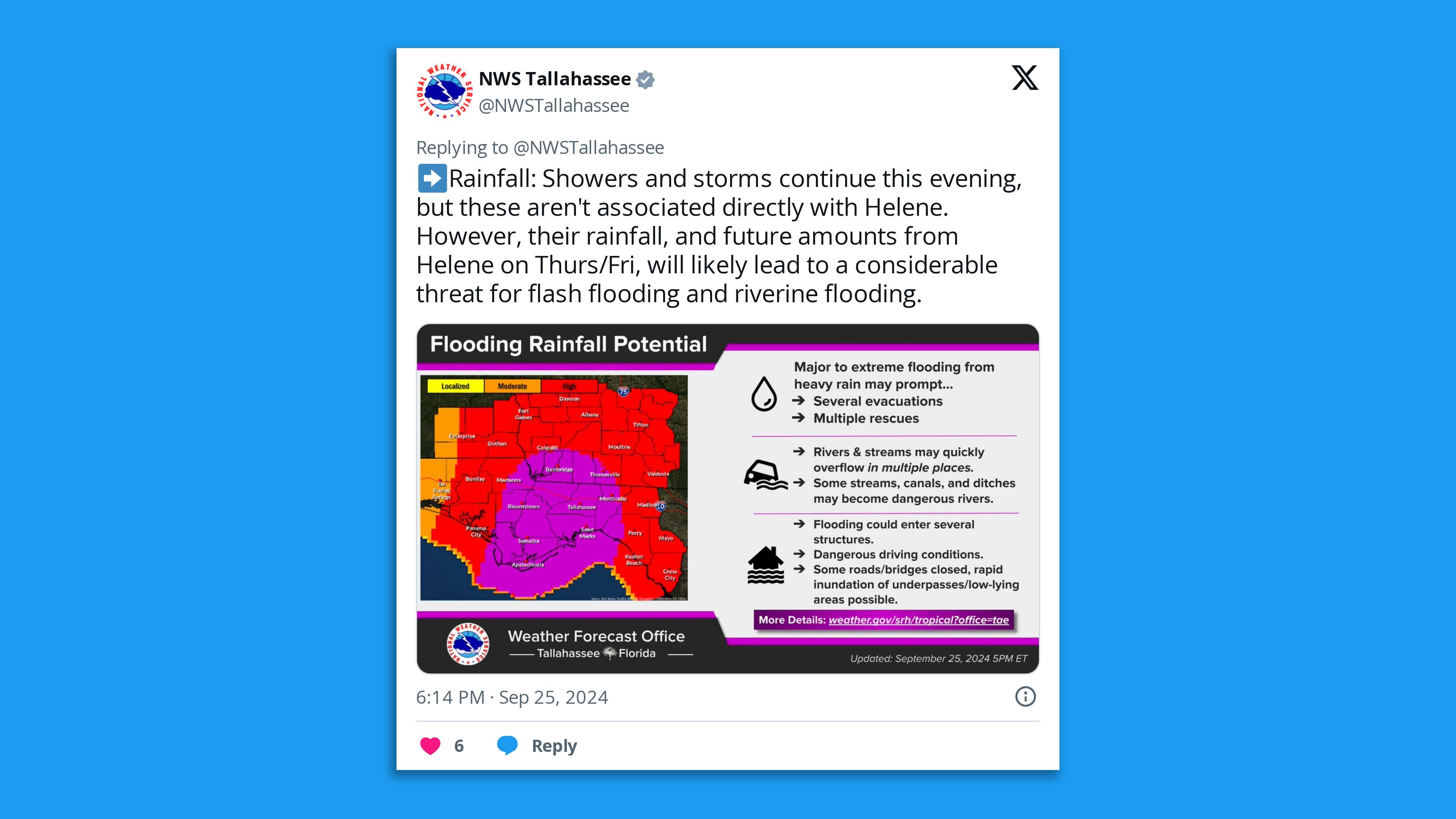
Helene’s potentially devastating flood threat
Between the lines: Computer models show the likelihood for extremely heavy rains to occur as a tropical air mass with record amounts of water vapor, moves across the Southeast.
- Atlanta, for example, could see as much as a foot of rain from this storm, with several inches falling in Nashville, Raleigh, Charlotte and other big cities.
- Rainfall amounts of up to 15 inches are forecast for the southern Appalachians between Wednesday evening and Friday, where a “high risk” of flash flooding, the most severe category, is forecast.
- “Considerable and potentially life-threatening flash and urban flooding is
expected across portions of Florida, the Southeast, the Southern
Appalachians, and the Tennessee Valley beginning today through
Friday,” the NHC stated Wednesday morning. - “This includes the risk of landslides across the southern Appalachians. Widespread minor to moderate river flooding is likely, and isolated major river flooding is possible.”
Context: Climate change is boosting global ocean temperatures, which were at record-high levels for more than a year straight.
- According to data from the nonprofit research group Climate Central, human-caused climate change made the current record-warm waters of the Gulf of Mexico between 200 to 500 times more likely. The water temperature in the storm’s path is extremely warm at 86°F, the NHC noted.
- There has been a documented trend toward more storms that rapidly intensify, and an amplification of the intensification rates in the Atlantic as well.
- Climate change is also causing hurricanes to produce more rainfall than they did a few decades ago.
The bottom line: Helene threatens to be a landmark storm that causes multibillion dollars worth of damage across the Southeast.