By Reuters November 23, 2026 | 10:50 pm PT
Singapore raised its 2026 GDP growth forecast to around 6% on Tuesday after the economy expanded 6.1% year-on-year in the third quarter, driven by an AI boost to the wholesale trade and manufacturing sectors.
AI-related production and exports, driven by a stronger-than-expected build-out of data centres, have continued to accelerate since August, the Ministry of Energy, Trade and Industry said in a press release.
The ministry upgraded its growth forecast after taking into account the performance of the economy in the first three quarters, it said.
 |
|
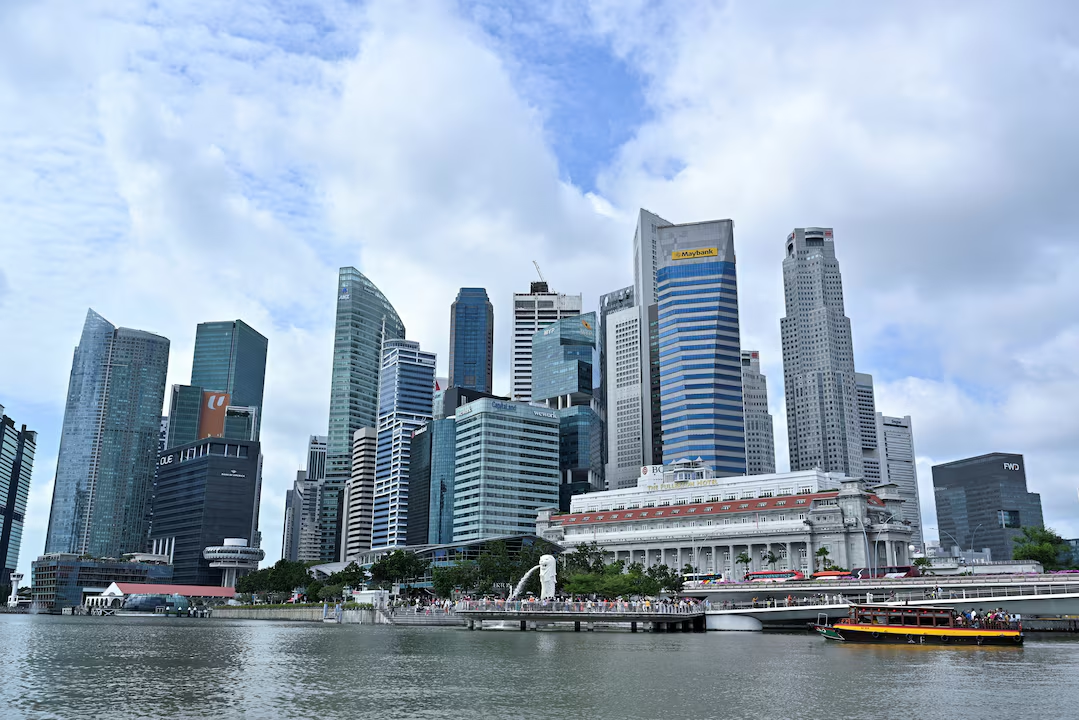
A view of the skyline in Singapore, Jan. 27, 2023. Photo by Reuters |
Maybank economist Chua Hak Bin said: “Singapore’s economy remains on full throttle. The upgrade to around 6% GDP growth in 2026 is largely technical, given how strong it has been for the first three quarters.”
The July-to-September growth was higher than an official advance estimate of 5.4% and above the 5.6% that was expected in a Reuters poll of economists.
On a quarter-on-quarter, seasonally adjusted basis, gross domestic product expanded by 1.5% in the July-to-September period, compared with an advance estimate of 1.1% growth.
The Ministry of Energy, Trade and Industry now expects 2027 GDP growth to be in a range of 2.5% to 4.5%.
Beh Swan Gin, the permanent secretary for the Ministry of Energy, Trade and Industry, said Singapore expects the strong momentum in global AI investments to continue for the rest of 2026 with the pace of growth in new AI investments moderating from its high this year.
Beh said the ministry also expects GDP growth in most of Singapore’s key trading partners, including the US and China, to moderate in 2027.
Chua said: “The main challenges will be the K-shaped recovery, with a subdued retail and food and beverage sectors, and weak job growth for modern services.”
In a separate statement, Enterprise Singapore, a government agency, upgraded its non-oil domestic export forecast to growth of 30% to 32% in 2026 from 14% to 16% previously.
In August, Singapore upgraded its growth forecast for this year to 4.5% to 5.5% from a previous range of 2.0% to 4.0%.
Singapore’s key consumer price gauge rose 1.5% in October from a year earlier.
Last month, the central bank kept its monetary settings unchanged in a move that surprised analysts, with inflation risks expected to ease slightly as the AI boom and supply constraints moderate.
OCBC economist Selena Ling said the central bank is likely to stand pat at its next review in January “given the comfortable core inflation print of 1.5% and expectations that another bump higher in Q127 should give way to a tapering from mid-2027.”
Last week, the US unveiled new rules that restrict shipments of advanced chips to some of the region’s major economies, including Malaysia, Singapore and Thailand, which some Chinese companies have used to access computing power to train AI models.
It also imposed new requirements on overseas data centres that supply “significant volumes of computing power” to firms based in China, dealing a blow to data centre and chip supply chain companies in Southeast Asia.
Beh said Singapore’s initial assessment of the impact of the rules on remote access to chips was that it would be manageable.
Beh said Singapore has had a moratorium on new data centre investments for several years and only accommodates new investments through tenders that are “relatively small compared to the size of the new data centre investments in other parts of the world.”
“Also, I think it is about the profile of the data centre operators in Singapore,” he said. “The vast majority are not serving remote access.”