
 |
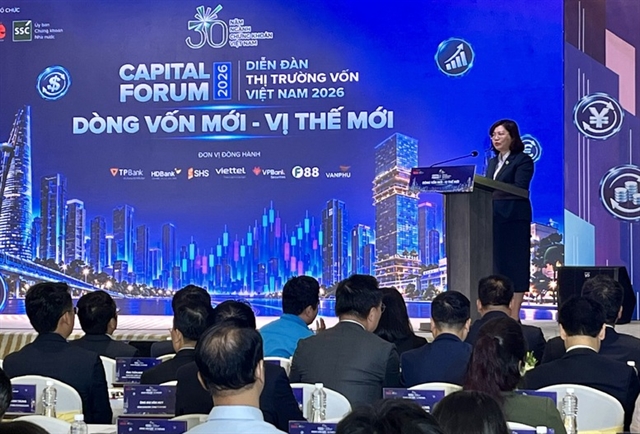
| Vũ Thị Chân Phương, chairwoman of the State Securities Commission (SSC) speaking at the Capital Forum 2026 in HCM City on October 30. — Photo baochinhphu.vn |
HÀ NỘI — Stock market needs to strengthen its role as a source of medium- and long-term financing for the economy and help reduce reliance on bank credit and attract more international investment as Việt Nam pursues ambitious growth targets for 2026-30.
The call comes as Việt Nam enters a new phase of capital market development following its upgrade by global index provider FTSE Russell to secondary emerging market status in September.
Developing capital market becomes critical as Việt Nam needs an estimated VNĐ38.5 (US$1.45 billion) quadrillion investment during 2026-30, while bank lending remains the dominant source of financing for the economy, experts said at the Vietnam Capital Forum 2026 in HCM City on October 30.
Vũ Thị Chân Phương, chairwoman of the State Securities Commission (SSC), said the stock market had gradually established itself as an important medium- and long-term capital mobilisation channel over the past three decades.
As of October 21, the equity market had a capitalisation of VNĐ10.16 quadrillion, equivalent to 79.1 per cent of estimated 2025 GDP, while the listed bond market was valued at around VNĐ2.94 quadrillion, or 22.9 per cent of GDP. The number of investor accounts had exceeded 14 million.
However, the market’s new status must be matched by improvements in corporate quality, transparency and the investment environment to translate the upgrade into sustainable capital inflows, she said.
Phương outlined major priorities for developing the stock market following its upgrade, including improving the legal framework, streamlining administrative procedures and modernising trading, payment and clearing infrastructure.
Other priorities include developing new financial products, improving the quality of listed securities, strengthening market supervision and gradually implementing a central counterparty (CCP) clearing mechanism for the underlying stock market.
The regulator would also promote digital transformation and technology applications in market management and supervision to ensure safe and stable operations.
Businesses, meanwhile, needed to improve competitiveness, operational efficiency and corporate governance, while listed companies should strengthen information disclosure, accountability and shareholder protection, she said.
They should also gradually adopt international standards for corporate governance and financial reporting to improve their appeal to institutional investors.
Phương said the upgrade to secondary emerging market status was not an end in itself but the beginning of a new development phase.
“The new position of Việt Nam’s stock market must be demonstrated not only through its upgrade, but also through market quality, corporate attractiveness and investor confidence,” she said.
Đinh Đức Minh, senior investment director at VinaCapital Fund Management JSC, said as banks are finding it increasingly difficult to shoulder most of the economy’s financing needs, given Việt Nam’s already high credit-to-GDP ratio, it is necessary to develop additional channels for long-term funding, particularly voluntary pension funds and the corporate bond market.
However, attracting international capital requires more than competitive borrowing costs.
Nguyễn Đỗ Hòa, director of the UK Export Finance (UKEF) in Việt Nam, Laos and Cambodia, said Vietnamese businesses needed to change their approach to seeking overseas financing.
Companies seeking financing from international financial institutions should demonstrate transparent operations, strong governance and the feasibility of their investment plans. They also needed to meet environmental, social and governance (ESG) standards, develop long-term business strategies and prepare reliable project cash-flow forecasts, he said.
Allan Nguyễn, chairman of EzyRemit Worldwide, highlighted the role of Việt Nam’s International Financial Centre in connecting domestic businesses with international capital.
He called for further improvements to the legal framework, greater stability and predictability in the investment environment, and the development of long-term investment products suited to pension funds.
He also called for a review of foreign ownership limits in certain business sectors, the development of foreign-exchange risk hedging instruments and faster equitisation and divestment of State-owned enterprises linked to stock market listings.
Nguyễn Hữu Huân, deputy chairman of the Executive Authority of the Việt Nam International Financial Centre in HCM City, said Việt Nam needs to improve the country’s sovereign credit rating to make it easier to access international financing. — VNS