HÀ NỘI — Trade and investment cooperation between Việt Nam and Chile has significant room for growth, underpinned by the complementary nature of their economies, a business conference heard in Hà Nội on Monday.
Speaking at the Chile-Việt Nam Business Forum, Chilean President José Antonio Kast said bilateral ties were built on a foundation of cooperation and a shared commitment to international economic integration.
Both countries view international trade and market expansion as key drivers of economic development and improvements in living standards, he said.
The Việt Nam-Chile Free Trade Agreement (VCFTA), which took effect in 2014, and their joint participation in the Comprehensive and Progressive Agreement for Trans-Pacific Partnership (CPTPP) have created a favourable framework for expanding trade, strengthening mutual trust and opening up new business opportunities.
However, the real value of such agreements should be measured by tangible results, Kast said, adding that businesses need to take the initiative to capitalise on opportunities by entering new markets, seeking partners, expanding production and carrying out investment projects.
Chile has strengths in mining, forestry, agriculture, livestock and fisheries, as well as substantial reserves of copper and lithium, which are essential resources for future industries, he said.
According to the Chilean leader, the country is keen to deepen cooperation with Việt Nam in technology, innovation and specialised professional services.
Agriculture and food processing also offer considerable potential, particularly in expanding market access for products from both countries. Further removal of trade barriers would help diversify bilateral trade and create opportunities for businesses and workers, he said.
As for investment, Kast said Chile aims to position itself as a stable and reliable destination for long-term projects, encouraging Vietnamese companies to explore opportunities and expand their operations there to access the wider Latin American market through Chile’s network of trade agreements.
Chile, in turn, is seeking to increase the presence of its businesses in Việt Nam and expand their operations across Southeast Asia.
He also highlighted the private sector’s role in turning cooperation opportunities into concrete results, praising business organisations and associations in both countries for helping connect markets and support companies, particularly small and medium-sized enterprises, in identifying opportunities.
 |
| Participants at the event. |
Shared economic interests
In his speech at the event, Minister of Industry and Trade Lê Mạnh Hùng said that despite the geographical distance between Việt Nam and Chile, the two countries share common interests in economic integration, open trade and market diversification.
Chile is one of Việt Nam’s key economic partners in Latin America, while Việt Nam is Chile’s largest trading partner in ASEAN. Bilateral trade reached approximately US$1.6 billion in the first 10 months of 2026, up 4 per cent from a year earlier.
While this growth is encouraging, trade remained modest compared with the potential for cooperation and the complementary strengths of the two economies, Hùng said.
Chile has strengths in minerals, industrial raw materials, agricultural products and mining technology, while Việt Nam has increasingly developed its production, processing and export capabilities in electronics, textiles, footwear, wooden products, agricultural goods and seafood.
“This provides a basis for both sides to move beyond simple goods exchanges towards linking production processes and integrating more deeply into value chains,” the minister said.
To translate this potential into tangible results, Hùng called on businesses and relevant authorities to make effective use of trade preferences under the VCFTA and CPTPP, seek partners, diversify products and markets, and strengthen links among industry associations, importers and distribution networks.
Business meetings at the forum should lead to concrete orders, contracts and viable projects, he said.
The two sides should also expand investment cooperation in sectors where their strengths complement each other, including mining and mineral processing, renewable energy, high-tech agriculture, food processing, supporting industries and green-transition technologies.
Priority should be given to projects involving technology transfer, workforce development and sustainable standards.
Meanwhile, both countries should work together to address trade barriers, including high logistics costs, long transportation distances, customs procedures, technical standards and quarantine requirements, Hùng said.
He added that relevant authorities should strengthen coordination to facilitate market access for each other’s products, while leveraging Chile’s role as a gateway to South America and Việt Nam’s position as a gateway to ASEAN.
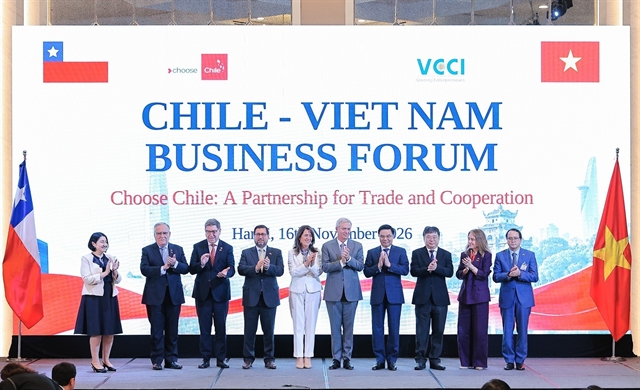 |
| Delegates pose for a group photo after the forum. |
Susana Jiménez, president of the Confederation of Production and Commerce, said Việt Nam’s population of more than 100 million, its dynamic economy and deep integration into global production chains have made the country an attractive destination for Chilean businesses.
“We are keen to learn from local experience and connect with partners to develop our business,” she said.
According to Jiménez, bilateral investment ties remain at an early stage, with both sides seeking to expand investment and explore projects that would support a longer-term presence in each other’s markets.
Tourism also offers opportunities to bring the two countries closer together. Increasing visitor flows in both directions could generate business for restaurants, hotels, tour guides and other service providers, she said.
She added that there is considerable scope to strengthen cooperation between travel companies and step up efforts to promote their respective tourism destinations.
Also at the forum, businesses from the two countries explored cooperation opportunities in the agriculture and food sectors, including prospects for exporting Chilean meat and fruit to Việt Nam. Vietnamese business representatives shared their views on the potential to deepen cooperation with Chile.
Discussions also covered logistics links, transportation costs, customs procedures, technical standards and quarantine requirements, with participants seeking to identify and address barriers to market access for businesses and products from both countries. — VNS