
HÀ NỘI — Việt Nam aims to move beyond expanding digital infrastructure and deploying artificial intelligence (AI) applications to build an ecosystem that enables Government agencies, businesses, universities and research organisations to use, master and gradually develop new technologies.
That was the message from Deputy Minister of Science and Technology Hoàng Minh speaking at the AWS Cloud and AI Day Hanoi on Tuesday.
He said science and technology, innovation and digital transformation had been identified as core drivers of the country’s development.
Việt Nam has so far developed 42 commercial data centres with a combined designed capacity of about 372MW. Nationwide connectivity has also expanded, with 4G covering 99.8 per cent of the population and 5G reaching about 91.9 per cent.
However, the Deputy Minister said infrastructure expansion and the deployment of individual applications alone would not be sufficient.
“What Việt Nam aims for is not only to expand infrastructure or deploy more AI applications, but, more importantly, to build an ecosystem in which Government agencies, businesses, universities and research organisations can use, master and gradually develop new technologies,” he said.
He outlined four areas of focus for Việt Nam.
The first is continued development of cloud infrastructure, data centres and computing capacity, with reliable, secure and scalable connectivity to meet the rapidly growing demands of AI and the digital economy.
The second is the development of data and AI platforms in a safe and effective manner, enabling Vietnamese businesses to harness data and technology to improve productivity, quality and competitiveness.
The third is accelerating the development of a technology workforce. Việt Nam needs not only people who can use technology, but also professionals capable of developing, integrating, operating and mastering new technologies.
The fourth, and most important, is ecosystem development.
“We want Vietnamese businesses not only to use Cloud and AI as a service, but gradually strengthen their technological capabilities, develop new products, services and business models, and participate more deeply in global value chains,” Minh said.
He also highlighted the important role of international technology groups in Việt Nam’s digital transformation, and praised AWS’s efforts in the country, including the launch of its AWS Local Zone in Hà Nội on June 19.
The Ministry of Science and Technology expects AWS and other international technology companies to continue working with Việt Nam not only through service provision, but also in infrastructure investment, workforce training, research, innovation and ecosystem development.
The ministry will work with relevant agencies to improve institutions, develop infrastructure and create a favourable, transparent and stable environment for domestic and foreign businesses to invest, operate and innovate in Việt Nam.
AI adoption accelerates
The push comes as AI adoption among Vietnamese businesses is gaining momentum.
According to the Unlocking Việt Nam’s AI Potential 2026 study released at the event, around 26 per cent of businesses, equivalent to about 245,000 enterprises, have officially integrated AI into their operations, up from 18 per cent in 2025.
Around 75,000 businesses adopted the technology for the first time over the past year.
The study found that AI adoption is moving beyond experimentation, with 75 per cent of businesses reporting productivity gains and 64 per cent saying AI had helped increase average revenue by 15 per cent.
Meanwhile, 71 per cent of businesses piloting AI said their investment had broken even or begun generating returns. AI adoption has been particularly strong in data-intensive sectors, including financial services, where 41 per cent of businesses are using AI, and healthcare, at 23 per cent.
Agentic AI is also emerging as a new productivity driver, with 81 per cent of businesses integrating the technology reporting noticeable productivity improvements.
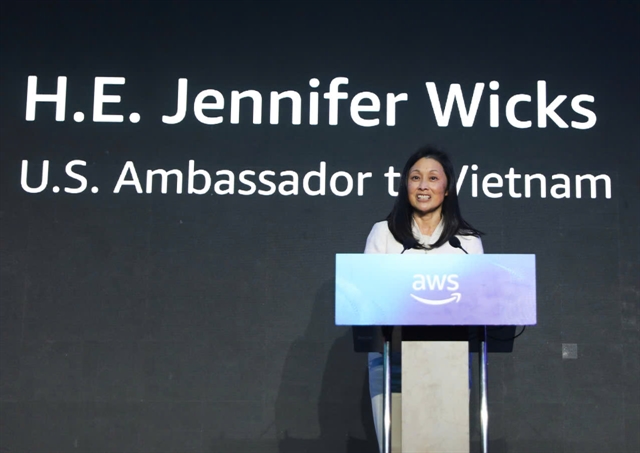 |
| US Ambassador to Việt Nam Jennifer Wicks speaks at the event. |
US Ambassador to Việt Nam Jennifer Wicks said technology and the infrastructure supporting it would be central to the shared vision of an innovative and prosperous digital economy.
She cited examples of AWS-supported digital transformation in Việt Nam, including Techcombank’s use of AWS to modernise its digital banking platform and Vietnamese company NamiTech’s use of AWS to power an AI platform for compliance in highly regulated industries.
Wicks also said the US Mission and American companies could support Việt Nam in areas including cloud computing, AI, cybersecurity, data governance and digital trade.
“Technology alone is not enough,” she said, stressing the importance of a regulatory environment that encourages innovation, attracts investment and enables international businesses to deploy new technologies efficiently.
.jpg) |
| Eric Yeo, Country General Manager Malaysia, Việt Nam, Indochina, at the event. |
Eric Yeo, Country General Manager Malaysia, Việt Nam, Indochina said: “AWS is here to support Vietnamese businesses’ ambitions. We recently announced the AWS Hanoi Local Zone, which brings AWS infrastructure closer to organisations in Việt Nam. We have also trained more than 157,000 people in Việt Nam in cloud and Al skills to date.”
AWS is also running the Việt Nam First Cloud & Al Journey programme to strengthen the pipeline of Vietnamese developers, with over 15,000 having gone through the program already since 2021.
“Việt Nam’s goal of becoming an ASEAN Al hub by 2030 is on track, marked by strong interest and adoption of the technology,” he added.
“Every organisation is at a different point in its Al journey, but the direction is clear. Businesses that move thoughtfully from experimentation to implementation, supported with cloud infrastructure, regulatory clarity, and skills will be best positioned to compete and grow.”
AWS Cloud and AI Day Hanoi brought together Government officials, technology companies and business leaders to discuss cloud, AI, data analytics, migration and modern applications. — VNS