
HCM CITY — Vietnamese food exporters must look beyond tariff advantages and meet the EU’s stringent food safety, packaging, and sustainability requirements if they want to expand sales in the bloc, a forum heard in HCM City on November 11.
The Vietnam Food Forum 2026, held as part of Vietnam Foodexpo 2026, focused on sustainable packaging and compliance with EU export regulations.
Organised by the Vietnam Trade Promotion Agency (Vietrade) in collaboration with the Swiss Import Promotion Programme (SIPPO) and other organisations, the forum sought to help Vietnamese food businesses keep abreast of changing EU consumer preferences and regulations, improve compliance, and strengthen their position in international supply chains.
Speaking at the event, Lê Hoàng Tài, deputy director general of Vietrade, said Việt Nam has considerable potential to expand food exports due to its abundant agricultural resources, improving processing capabilities, and deeper participation in international supply chains.
The EU is among the most promising markets for Vietnamese food products, with the EU-Việt Nam Free Trade Agreement (EVFTA) creating favourable conditions for market access, but the bloc’s stringent and frequently modified regulations on food safety, quarantine, traceability, and environmental protection pose major challenges, he said.
He highlighted the EU’s new Packaging and Packaging Waste Regulation, which introduces additional requirements for recyclability, waste reduction, and the use of environmentally friendly materials.
“Packaging is no longer merely a means of preserving, transporting and presenting products, but is increasingly becoming a key factor determining businesses’ ability to meet market standards and participate in supply chains in the EU market.”
He urged Vietnamese businesses to keep abreast of regulatory changes, review their production processes, and select appropriate packaging solutions, while paying greater attention to recyclability, waste reduction, and food contact safety.
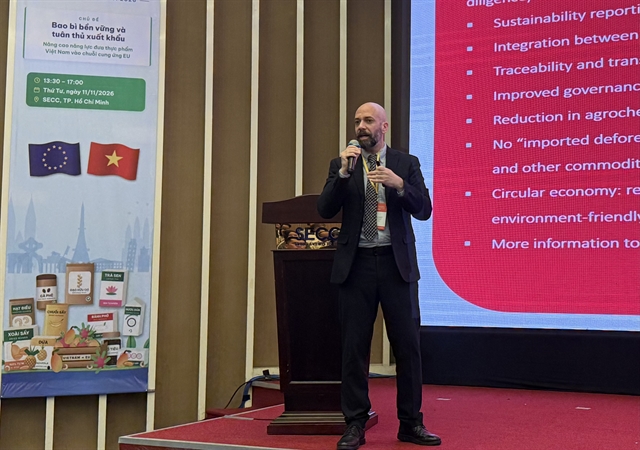 |
| Gustavo Ferro, an expert in processed food and natural ingredients at the Swiss Import Promotion Programme, speaks about EU food market trends, including consumer preferences and product and packaging requirements, at the Vietnam Food Forum in HCM City on November 11. — VNS Photo |
Gustavo Ferro, an expert in processed food and natural ingredients at SIPPO, outlined key market trends in Europe, where buyers are imposing increasingly stringent food safety requirements that often go beyond statutory standards.
He identified several major developments, including greater emphasis on food safety and compliance, the expansion of private labels, rising demand for healthier food, and the development of sustainable value chains encompassing regulation, innovation, packaging, and circularity.
European supermarkets are placing greater emphasis on food safety and expect suppliers to go beyond basic regulatory compliance, he said.
They are tightening controls on pesticide residues and increasingly requiring internationally recognised food safety certification such as BRCGS, IFS, GlobalG.A.P., and FSSC 22000, he said.
Ferro advised businesses to view food safety compliance as an investment by strengthening preventive controls, documentation and traceability, while maintaining transparent communication with buyers.
But despite these challenges, the European market offers opportunities for Vietnamese producers, particularly in private-label products and health-oriented food segments.
The growing popularity of supermarket-owned brands in countries such as Switzerland and the Netherlands offers opportunities for Vietnamese manufacturers to supply retailers, as consumers increasingly seek affordable alternatives amid cost-of-living pressures.
Demand is also rising for natural ingredients, clean-label products, plant-based alternatives, and foods with reduced salt and sugar content.
However, suppliers must ensure consistent quality, reliable production capacity, and sufficient financial resources, while meeting retailers’ food safety and sustainability standards, he said.
Sustainability is no longer merely a market trend but is becoming an increasingly important compliance requirement under the EU’s regulatory framework, he said.
European buyers want more information about suppliers’ raw materials, packaging, and wider supply chains.
He encouraged Vietnamese exporters to establish sustainability policies and codes of conduct, review their supply chains, and identify opportunities to create added value through circular products and more sustainable packaging.
Non-tariff barriers
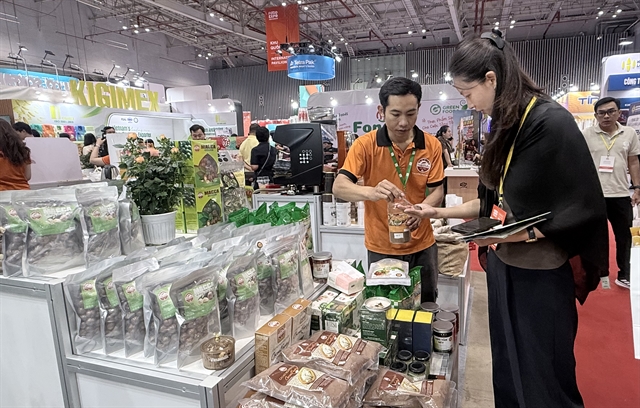 |
| A booth at the Vietnam Foodexpo 2026. — VNS Photo |
Ngô Xuân Nam, deputy director of the Vietnam Sanitary and Phytosanitary Notification Authority and Enquiry Point (Vietnam SPS Office), said Vietnamese exporters face a new wave of non-tariff barriers even as tariff preferences under the EVFTA continued to expand.
He outlined three key regulatory areas that food packaging destined for the EU must address: food contact safety, environmental requirements under the new packaging regulation, and consumer-facing claims and information.
“Each layer has a different legal basis and compliance approach. Failure to comply with food contact safety requirements may result in border rejection, while misleading environmental or consumer claims may lead to enforcement actions in the marketplace.”
He pointed out that compliance with Vietnamese regulations does not automatically ensure compliance with EU requirements.
He recommended that exporters review all packaging materials, obtain the necessary compliance documents, and arrange testing for substances such as bisphenol A (BPA) and per- and polyfluoroalkyl substances (PFAS) at accredited laboratories.
They should also clarify responsibilities with EU partners and gradually switch to recyclable, mono-material packaging.
Lương Phước Vinh, country manager of Tentamus Vietnam, highlighted the importance of meeting EU sanitary and phytosanitary requirements to maintain market access.
Exporters investing in regulatory compliance, traceability and documentation would be better placed to minimise risks and build trust with EU buyers, he said.
Vietnamese products meet only a modest share EU import demand, meaning they have considerable room for growth.
Specialised information systems can help exporters access standards, product codes, residue limits and rapid alerts in Vietnamese, enabling them to respond promptly to potential problems before these become barriers to trade, he added. — VNS