
HCM CITY — Vietnamese businesses are being encouraged to capitalise on tariff preferences under the Comprehensive Economic Partnership Agreement (CEPA) between Việt Nam and the United Arab Emirates (UAE) to expand exports to the Gulf region, the Middle East and Africa.
The Investment and Trade Promotion Centre of HCM City (ITPC), in collaboration with the Agency of Foreign Trade under the Ministry of Industry and Trade, held a seminar in HCM City on October 23 to help businesses understand the agreement’s commitments, rules of origin and market access opportunities.
Speaking at the seminar, Lê Anh Hoàng, deputy director of ITPC, said diversifying export markets and making effective use of free trade agreements had become increasingly important amid global trade uncertainties.
He described the UAE as both a promising consumer market and a strategic trade and logistics hub connecting Việt Nam with the Gulf Cooperation Council (GCC), the wider Middle East and Africa.
According to customs data compiled by the ministry, bilateral trade reached approximately US$6.6 billion in 2025, including more than $5.9 billion in Vietnamese exports.
In the first half of 2026, two-way trade totalled $3.2 billion, up 0.2 per cent year-on-year, although Việt Nam’s exports to the UAE fell 16.4 per cent.
The CEPA, which took effect on February 3, 2026, commits the UAE to eliminating tariffs on 74.2 per cent of tariff lines immediately, rising to 89.2 per cent after five years, giving Vietnamese exporters a competitive advantage.
However, Hoàng cautioned that tariff preferences would not automatically translate into export orders unless businesses complied with rules of origin, certification requirements, quality standards and distribution regulations.
Phạm Bình An, former deputy director of the HCM City Institute for Development Studies, highlighted opportunities for Vietnamese agricultural and food exporters.
The UAE’s GDP reached $518 billion in 2025, with non-oil sectors accounting for 77 per cent of economic output. With limited agricultural land, the country imports 85-90 per cent of its food requirements.
However, An warned that lower tariffs did not necessarily mean easier customs clearance, given stringent technical barriers, sanitary and phytosanitary requirements and Halal standards.
He stressed that Halal compliance required strict controls throughout the supply chain, from raw material sourcing and production to storage and transportation, while certification must be recognised by the UAE’s competent authorities.
Businesses should also verify trading partners carefully and recognise that Vietnamese goods re-exported from the UAE to third countries would not automatically qualify for CEPA preferences.
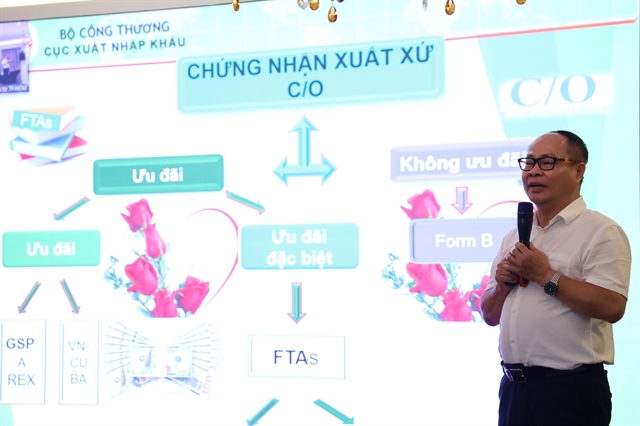 |
| Trần Ngọc Bình, head of Regional Import-Export Management Division III under the Agency of Foreign Trade, outlines steps Vietnamese businesses should take to capitalise on CEPA at the seminar. |
Trương Xuân Trung, head of the Vietnam Trade Office in the UAE, recommended a three-stage market entry strategy targeting the UAE, other GCC countries, and the wider Middle East and Africa.
He said exporters should initially use the UAE to test products, assess demand and build brand recognition, particularly for agricultural produce, processed foods, textiles, footwear and furniture.
They could subsequently expand into other GCC markets, benefiting from the bloc’s customs union, before entering other Middle Eastern and African markets through strategies tailored to individual countries and product categories.
Trung also recommended flexible distribution models, including direct exports, UAE-based intermediaries and local warehousing, while prioritising long-term partnerships with importers, retail chains, logistics providers and e-commerce platforms.
Addressing technical requirements, Trần Ngọc Bình, head of Regional Import-Export Management Division III under the Agency of Foreign Trade, highlighted Circular No. 24/2026/TT-BCT on rules of origin.
He said the CEPA included a commonly applied qualifying value content threshold of 35 per cent and a de minimis provision allowing non-originating materials to account for up to 20 per cent of ex-works value.
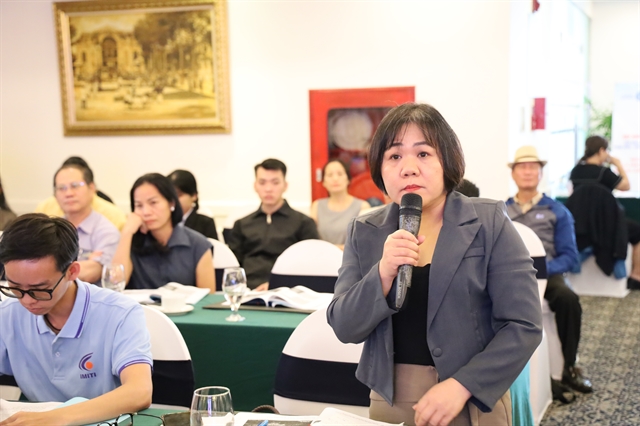 |
| A business representative asks a question at the seminar. — Photo courtesy of ITPC |
Together with bilateral cumulation rules, these provisions could help Vietnamese textile, garment and footwear exporters qualify for preferential tariffs.
The agreement also permits electronic certificates of origin, retrospective issuance and self-certification for eligible exporters.
Trần Xuân Trang, head of ITPC’s Foreign Trade Development Promotion and Domestic Market Division, said the UAE was Việt Nam’s largest trading partner in West Asia, accounting for more than half of its exports to the region.
However, exporters still faced challenges including high transport costs, lengthy shipping times, technical and Halal requirements, international payment risks and limited market information.
To address these barriers, ITPC plans to develop a long-term trade promotion strategy focusing on four product groups: agricultural and processed foods, textiles and garments, footwear, and consumer goods and wooden furniture.
The centre will provide specialised training on Halal standards, international supply chains and trade agreements, alongside updated market information.
It will also support businesses attending major trade exhibitions in Dubai and Cairo and facilitate business matching and digital trade connections to strengthen Vietnamese products’ presence in the UAE and neighbouring markets. — VNS