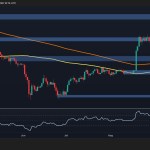
Traders appeared unable to convert the $80,000 level into lasting support. At the same time, gold also turned lower after recent strength, with XAU/USD falling toward $4,605 per ounce, down nearly 2% on the day.
Key takeaways
- Bitcoin’s attempt to hold $80,000 support weakened during US trading hours, sending BTC/USD down to the high-$70,000s.
- Gold’s pullback—after multimonth highs—suggests broader risk momentum cooled rather than a bitcoin-specific move.
- Bond yields eased, but expectations around rate cuts remain constrained by the inflation backdrop.
- Market attention is moving toward US inflation data (PCE) and Nvidia earnings, which could swing risk assets again.
$80,000 fails to hold as risk assets diverge
The same pattern emerged in gold markets. XAU/USD printed local lows near $4,605 per ounce after sitting at multimonth highs earlier, reflecting a shift in how investors were positioning across traditional and crypto assets.
Treasury yields cool, but the rate-cut path looks limited
Despite the drop in Bitcoin, US government bond yields were also easing. The day’s move saw 30-year yields fall below 5.2% and head toward their lowest levels since Aug. 7. The article also noted that last week’s crypto rebound coincided with yields reaching levels not seen since January 2007, when the US Treasury announced larger debt buyback operations aimed at curbing the upward pressure on rates.
Commentary from The Kobeissi Letter suggested that the usual playbook—interest rate cuts to improve liquidity—may not be realistic under current inflation conditions. In a post on X, the account argued that the Fed “cannot cut rates in this environment,” pointing instead to direct Treasury-related actions as the mechanism likely to push yields lower in the short run. The same post cautioned: “Don’t fight the Treasury.”
What’s next: PCE and Nvidia earnings
With bond-market dynamics no longer the only driver, traders are turning to upcoming catalysts. QCP Capital said it is shifting attention away from Treasury moves toward fresh US inflation readings and the Jackson Hole economic symposium, scheduled for Aug. 27–29.
Wednesday’s calendar includes the July Personal Consumption Expenditures (PCE) index—described as the Fed’s preferred inflation gauge. The source also reminded readers that PCE saw its first month-on-month decrease since 2020 in the prior reading, with that improvement occurring in the June data.
Closing perspective
Whether Bitcoin stabilizes above $80,000 may depend less on yesterday’s technical levels and more on what Wednesday’s PCE number and Nvidia’s results signal for liquidity expectations. Until those catalysts land, the market appears poised to keep reacting in lockstep with—rather than distinct from—traditional assets.