
The market is now stuck between safe-haven demand and macro pressure. Every news update around Iran or Hormuz moves price fast, but those moves fade quickly. That is why gold keeps ranging instead of breaking into a clear trend.
Gold Price Analysis
On the chart, gold is still in a corrective phase within a broader upward trend. Price moved above the typical resistance zone expected for a wave (4) and also crossed the 61.8% retracement level. That move lowers the probability of a simple corrective count, but it does not rule it out.
Another view is that the current move is part of a larger flat correction. In that case, price could still move slightly higher as part of a B-wave before turning lower into a C-wave. This would keep gold stuck in range for a bit longer.
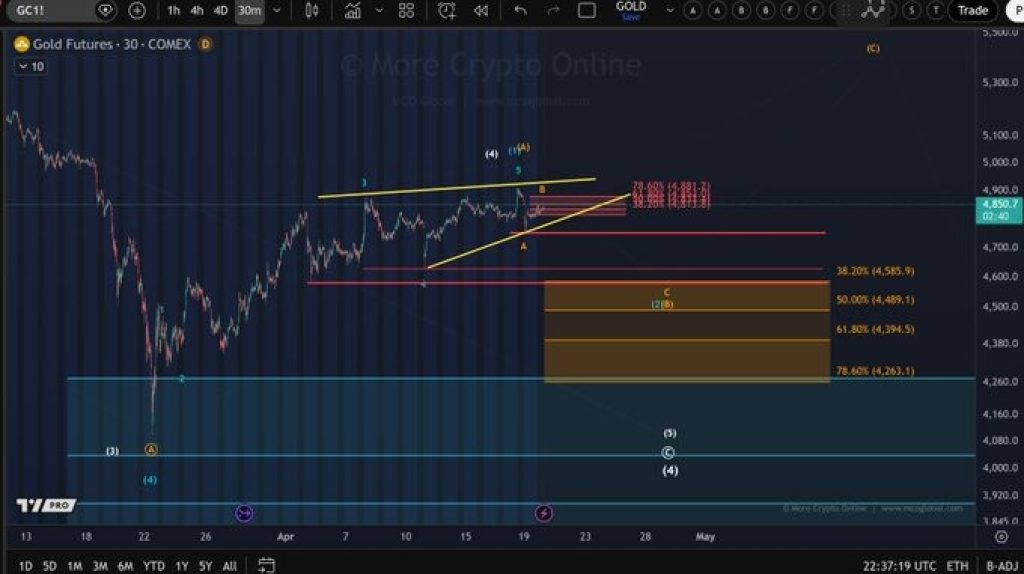
The key level remains $4,750. A break below this level would be the first clear sign that a local top may be forming. As long as gold stays above that level, buyers still have control, even if the move is not strong.
Resistance is close to $4,800-$4,820. If prices move above $4,890, then gold price can once again test $5,000. For now, prices are ranging between support and resistance, awaiting direction.
Gold News: What’s Driving it Right Now
Gold has seen strong volatility in April. After reaching an all-time high of $5,594.82 in January, price has pulled back into the $4,700–$4,800 range. That marks a drop of about 8%–9% during this phase of the Middle East conflict.
The main driver is the US–Iran situation. In late March 2026, military strikes in the region led to the closure of the Strait of Hormuz, a key oil route. Oil prices climbed above $100–$110 per barrel. That brought inflation fears back into markets.
Military actions through March and April have kept uncertainty high. At the same time, talks around possible ceasefires have brought some calm today, which has limited further upside in gold.
The US dollar is also playing a role. A stronger dollar and elevated interest rates are pulling demand away from gold since it does not provide yield. This has made it harder for price to hold above $4,800.
On the demand side, central banks continue to buy. Countries like China, Poland, and India are expected to push total purchases past 1,000 tonnes in 2026. This steady demand is helping create a floor under price.
Supply remains tight. Mine output is growing slowly, around 1%–2% each year. In India, high prices have reduced jewelry demand, and some households are selling or using gold as collateral, adding short-term supply into the market.
ETF inflows have picked up again in 2025–2026, reversing earlier outflows as investors return to gold exposure during periods of uncertainty.
Frequently Asked Questions
Subscribe to our YouTube channel for daily crypto updates, market insights, and expert analysis.