
Gold prices have edged down as the war in the Middle East has caused investors to temporarily shift toward the dollar, though the long-term outlook for the metal remains optimistic, analysts said.
They are now in the US$5,000–5,100 range, down from $5,400 at the beginning of the attacks on Iran by the United States and Israel.
 |
|
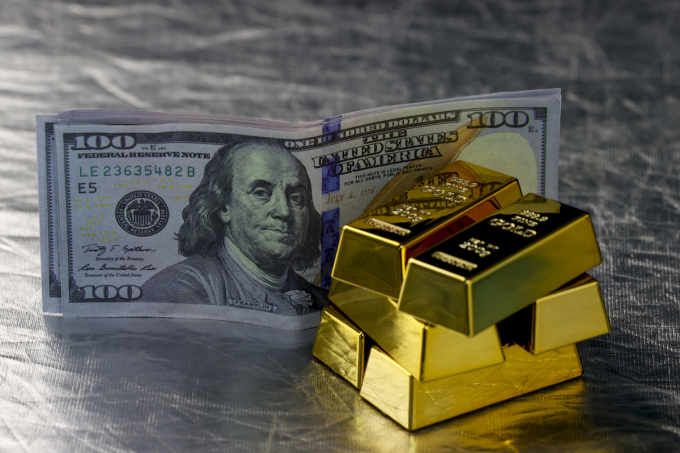
In this photo illustration, U.S. dollar banknotes and gold bars are seen in Ankara, Turkey on Jan. 29, 2021. Photo by Anadolu via AFP |
Huynh Trung Khanh, vice chairman of the Vietnam Gold Business Association, said the correction is temporary. Gold has been pressured downward by a stronger greenback, he explained.
A surge in oil prices to beyond $100 on March 8 before falling back to around $90, fueled inflation concerns and pushed the U.S. Dollar Index close to the 100-point mark.
Besides, a decline in stock markets across the U.S., Asia and Europe forced some investors and funds to sell gold to meet margin calls.
“During periods of strong market volatility, demand for cash, particularly the U.S. dollar, increases, causing funds to temporarily exit gold,” Khanh told VnExpress.
Bui Van Huy, vice chairman of FIDT Investment Consulting and Asset Management Company, concurred with him, saying holding U.S. dollars during periods of market volatility allows investors to seize opportunities when other assets correct to attractive levels.
From a supply-demand perspective, moves by central banks have also drawn attention. The National Bank of Poland is considering selling 100–200 tons of gold to supplement its defense budget.
Overall, the trend of gold accumulation by central banks worldwide remains intact, though the People’s Bank of China’s officially published figures show only purchases of one or two tons a month.