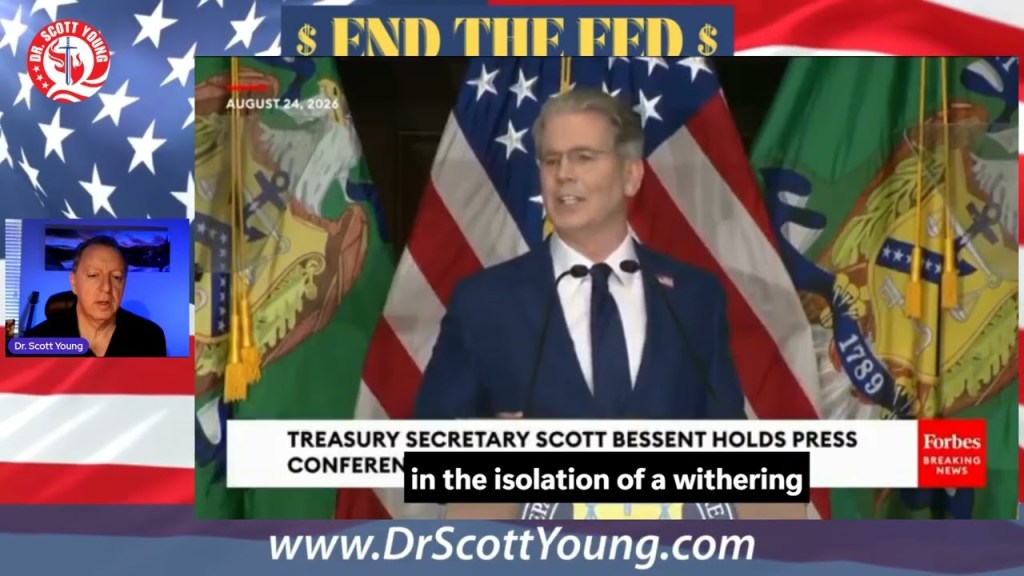
In an era defined by political division and escalating financial anxieties, it is easy to become numb to the gravity of headlines concerning national debt and government instability. Yet, according to Dr. Scott Young’s recent analysis, the current convergence of crises—ranging from political shutdowns to an unstable banking sector—is not just temporary turbulence; it represents profound systemic risks tied directly to historical patterns of financial mismanagement.
Dr. Young offers a sober, expert assessment of the challenges facing the U.S. government and financial system today, tracing these contemporary fears back through history and illuminating the dangerous path created by unchecked debt accumulation and aggressive monetary policies.
The threat of political gridlock leading to government shutdowns is more than just a political inconvenience—it erodes confidence and introduces operational instability into an already stressed economy. Dr. Young points out that these shutdowns are symptomatic of a deeper inability to govern responsibly and address fundamental financial realities.
The U.S. national debt has reached unsustainable levels. Dr. Young emphasizes that this accumulation is not merely a number on a ledger; it is the source of systemic risk that eventually dictates monetary policy and limits future governmental responsiveness. The sheer size of the debt exponentially increases the stakes when market volatility strikes.
Despite assurances, instability within the banking sector remains a significant concern. Past crises have shown that once confidence is lost, contagion spreads rapidly. Dr. Young links this contemporary fragility to historical precedents, arguing that aggressive monetary policy often masks underlying weaknesses until a trigger event exposes them.
A major focus of Dr. Young’s discussion is the crucial, yet increasingly precarious, role of the Federal Reserve.
When the financial system seizes up, the Fed steps in as the “lender of last resort.” Dr. Young elaborates on specific tools the Fed utilizes to stabilize markets, namely repo operations (Repurchase Agreements) and Quantitative Easing (QE). While these interventions can provide necessary liquidity in the short term, they also carry massive implications, contributing to inflation and distorting natural market cycles.
The long-term danger, Dr. Young suggests, is the ever-increasing reliance on these policies. When the economy is chronically dependent on Fed intervention to function, the ability of the system to correct itself naturally is compromised, making the next inevitable crisis potentially far more severe.
This cycle is crucial because it illustrates that the steps being taken today (rate hikes, liquidity i********s) are often precursors to the next phase of distress.
For Dr. Young, these are not just theoretical concepts. He recounts personal experiences during past financial downturns, powerfully illustrating how deeply these problems penetrate the lives of ordinary people, destroying businesses and wiping out savings. This personal perspective underscores the urgency of addressing systemic flaws before market forces inflict widespread pain.
Dr. Young concludes his discussion not with panic, but with a call for resilience.
Recognizing the feeling of powerlessness many face when confronted with overwhelming governmental debt and systemic instability, he offers a historical perspective on endurance. He invokes the Gunpowder Plot of 1605—a metaphor for historical resistance against autocratic power and political turmoil.
While not advocating for physical resistance, Dr. Young uses this imagery to remind us that throughout history, difficult times demand courage, patience, and unwavering belief in fundamental principles. Navigating the current economic and political turmoil requires preparation, awareness, and the fortitude to remain steady while the system undergoes painful, necessary adjustments.
The challenges facing the U.S. financial system are complex and deeply entrenched. Understanding the mechanisms of debt, the limits of the Federal Reserve, and the historical cycle of crisis is the first step toward safeguarding one’s financial future.
Watch the full video from Dr. Scott Young for further insights and information on navigating the current financial turbulence.