HÀ NỘI — Hà Nội is stepping up efforts to strengthen small and medium-sized enterprises (SMEs), improve their access to finance and technology, and foster business linkages as the capital seeks to sustain growth and transform its economic model, a conference heard on Friday.
Speaking at the conference, Lê Trung Hiếu, deputy director of the Hanoi Department of Finance, said policy initiatives on private-sector development, capital city development and national development strategies were creating new opportunities for the business community.
Despite a complex and volatile global economic environment, Hà Nội’s economy continued to maintain positive growth momentum, he said.
The city’s budget revenue hit an estimated VNĐ652 trillion (US$24.9 billion) in the first 10 months of this year, exceeding the annual target by 0.3 per cent and rising 11.2 per cent from a year earlier. Public investment disbursement reached VNĐ118.2 trillion.
Urban railway projects with estimated investment of around VNĐ1 quadrillion during the 2026-30 period, alongside other major transport infrastructure developments, would create significant opportunities for domestic businesses to supply goods and services and participate in project implementation, Hiếu said.
However, businesses would need to address constraints related to capital, production space, technology, human resources and management, as well as strengthen their ability to establish partnerships with major corporations to capitalise on these opportunities.
“We consider the development of enterprises to be a key metric reflecting the effectiveness of the city administration’s management and governance,” Hiếu said, adding that a strong business community was essential to Hà Nội’s rapid and sustainable development and competitiveness.
Business prospects and challenges
Cấn Văn Lực, chief economist at BIDV and a member of the National Financial and Monetary Policy Advisory Council, said Hà Nội had maintained strong growth momentum in 2026, with the city undergoing what he described as significant transformations.
However, he cautioned that businesses, particularly SMEs, should prepare for potential volatility in tariffs, interest rates, exchange rates and market conditions, as well as the growing impact of climate change.
Global investment in artificial intelligence (AI), data and high technology was creating new growth opportunities, while disparities in performance across industries were becoming increasingly pronounced.
Lực urged SMEs to make greater use of available support policies, including tax, fee and interest-rate incentives, while accelerating technology adoption, streamlining operations and cutting costs.
He also called on businesses to pursue a four-pronged transformation encompassing digitalisation, the green transition, energy transition and workforce transformation.
SMEs should diversify their markets, business partners, supply chains, products and services, while making better use of free trade agreements and participating more actively in carbon markets, he said.
They should also diversify funding sources, strengthen financial management and risk mitigation, and integrate AI and data analytics into business operations.
Building stronger internal capabilities was equally important, requiring investment in human resources, technology, management practices and corporate culture, alongside the adoption of environmental, social and governance standards.
Businesses should also improve transparency in the origins of goods and raw materials and the protection of intellectual property, while increasing self-reliance and tapping more effectively into the domestic market, Lực said.
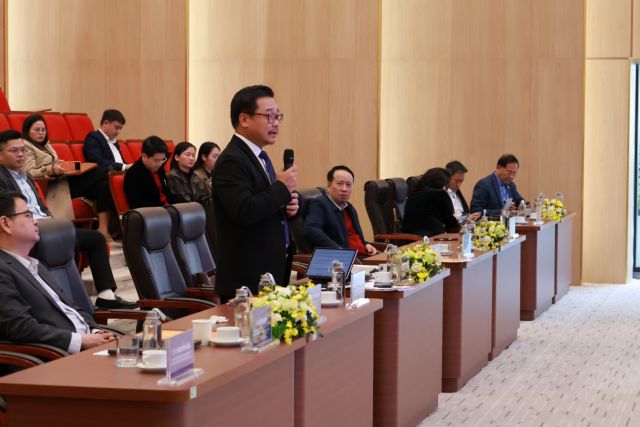 |
| Participants at the event. |
Tailoring support to business needs
From the business community’s perspective, Mạc Quốc Anh, vice chairman of Hanoi Association of Small and Medium Enteprises (HANOISME), said Hà Nội saw around 27,800 new enterprises established in the first 10 months of 2026, roughly unchanged from the same period last year. Newly registered capital, however, surged 57.4 per cent to VNĐ537.5 trillion.
Nearly 11,500 businesses resumed operations during the period, up 32 per cent year-on-year. At the same time, around 27,800 enterprises registered to suspend operations, an increase of 9.7 per cent, while 12,600 were dissolved, up 59.2 per cent.
These figures showed that business support policies needed to pursue two objectives simultaneously: helping enterprises return to the market and strengthening their ability to maintain stable operations, Anh said.
He cautioned that the increase in newly registered capital did not necessarily mean SMEs had gained access to actual funding for production and business activities. Support measures should therefore be tailored to businesses’ operational status, products, existing contracts, financing needs and repayment capacity.
HANOISME called on the Government to further refine mechanisms for financial consultancy, credit guarantees and credit connections, while standardising application documents, eligibility criteria and approval procedures for business support programmes.
It also proposed developing an SME database with indicators broken down by locality, business size and industry to enable more effective assessments of policy outcomes.
For Hà Nội, the association proposed a dedicated support programme for 2027, featuring a detailed list of services, designated implementing agencies, clear timelines and specific budget allocations.
The programme should initially target selected groups of businesses with genuine support needs, particularly those seeking to resume operations, expand into new markets or improve their operational capabilities, Anh said.
Relevant departments, agencies, local authorities and business associations should publicly identify their contact points, eligibility requirements, responsibilities for handling applications and expected response times.
HANOISME also offered to help consolidate businesses’ support needs, connect enterprises with experts and gather feedback from companies after they receive assistance. — VNS