Việt Nam is stepping up economic engagement with Cambodia, Laos and Myanmar, with growing trade flows complemented by investments in manufacturing, telecommunications and cross-border energy.
The scale of trade and investment among the CLMV countries – Cambodia, Laos, Myanmar and Việt Nam – highlights their growing role in the ASEAN economy. The four countries’ combined trade with the world reached more than US$1 trillion in 2025, accounting for 23.8 per cent of ASEAN’s total trade. Foreign direct investment inflows into the group totalled around $30.5 billion, up 11.4 per cent from 2024.
For Việt Nam, CLMV has brought opportunities to expand exports, develop manufacturing investments and strengthen supply-chain links with neighbouring markets.
Cambodia remains one of Việt Nam’s key trading partners in the Mekong subregion. Trade between Việt Nam and Cambodia reached approximately $11.4 billion in 2025, an increase of more than 12 per cent. In the first eight months of 2026, the figure totalled nearly $8.7 billion.
Việt Nam is currently Cambodia’s largest trading partner within ASEAN. Leaders of the two countries have agreed on a target of raising bilateral trade turnover to $20 billion in the near future.
Việt Nam has poured $3.4 billion into 223 investment projects in Cambodia, spanning agriculture, telecommunications, finance and banking, aviation, food processing, trade and services. Meanwhile, Cambodian businesses have invested in 50 projects in Việt Nam, with total capital of $81.6 million.
Uch Leang, Acting Director of Asian, African, and Middle East Studies at the International Relations Institute of Cambodia under the Royal Academy of Cambodia, noted that Việt Nam and Cambodia share many common interests in improving CLMV and ACMECS cooperation.
Việt Nam is an important partner in trade, investment, agriculture, infrastructure and human resources development, while a stable Cambodia with stronger connectivity with regional economic corridors will also benefit Việt Nam.
He called on the two countries to enhance coordination in cross-border projects, particularly in transport, logistics, agricultural trade, energy and management of Mekong water resources.
Trade between Việt Nam and Laos also reached a record US$2.98 billion in 2025, up 32.7 per cent from the previous year. Two-way trade exceeded US$1.6 billion in the first nine months of 2026. The two countries target bilateral trade of $4 billion this year and $10 billion by 2030.
Laos is Việt Nam’s largest overseas investment destination. Vietnamese businesses have had 435 projects there, with registered capital of nearly US$8 billion, according to Việt Nam’s Ministry of Finance.
In the first nine months of 2026, Vietnamese companies launched 24 new projects in Laos, with total investment of $670 million, 1.7 times higher than the figure in the same period last year. The investment is concentrated in energy, agriculture, services, manufacturing and infrastructure.
Vietnamese Ambassador to Laos Nguyễn Minh Tâm said Việt Nam and Laos should deepen energy cooperation and develop interconnected production value chains between their two economies.
Both countries should also seek to deliver tangible improvements in institutional frameworks, the investment climate, trade and market connectivity. This would require continued efforts to refine policies, streamline administrative procedures and facilitate investment, business operations and import-export activities.
Business activities
Việt Nam-Myanmar trade remains below previous levels. Bilateral trade fell from $853 million in 2020 to $590 million in 2025, reaching $335 million in the first six months of 2026, according to Việt Nam’s Ministry of Industry and Trade.
As of June 30, Việt Nam had only 107 valid projects in Myanmar with total registered capital of $1.4 billion. Despite those figures, Việt Nam is still among the largest foreign investors in Myanmar.
Myanmar expects Vietnamese businesses to invest in agricultural processing plants, cold storage facilities, logistics, food production, fisheries and agricultural inputs. The two countries want to enhance cooperation in digital infrastructure, cybersecurity, public services, digital payments and the manufacturing of technology equipment in high-tech parks, according to Việt Nam’s Ministry of Industry and Trade.
Vietnamese companies expand their regional footprint. Viettel has established a significant presence in telecommunications and digital infrastructure through its Unitel, Metfone and Mytel brands in Laos, Cambodia and Myanmar, respectively.
According to Viettel, in the first nine months of 2026, Unitel’s revenue in Laos reached $142.1 million, up 25.2 per cent year-on-year, while profit rose by 6.8 per cent to $39.2 million. Meanwhile, Metfone’s revenue in Cambodia grew by 7 per cent in the first half of 2026. The company also set its full-year revenue target of $1 billion in 2026 for Mytel in Myanmar.
Energy is another important investment area between Việt Nam and Laos. T&T Group’s Savan 1 wind power project in Savannakhet province began commercial operations on December 26, 2025. Its first phase with an investment of more than US$490 million has a capacity of 300 MW, supplying electricity to Việt Nam.
According to the company, the project has generated approximately $36.5 million in revenue after nearly seven months of commercial operations. The full Savan 1 project is planned to have a capacity of 495 MW, with total investment of about $768 million.
In October, T&T Group and Vinacom Investment and Trading Company signed a memorandum of understanding to develop the Savan 2 wind power project in Laos. The project is expected to have a capacity of 495 MW and a total investment of about $768 million. It is expected to begin commercial operations by the end of 2028.
Besides those projects, the two countries are also studying options for a 500 kV power grid connection from northern Laos to northern Việt Nam.
Further support
In food manufacturing, Vinamilk’s Angkor Milk project in Cambodia illustrates the shift from exporting products to investing directly in production and developing local supply networks. Vinamilk has invested a total of $51.7 million in Angkor Milk. In 2025, Angkor Milk’s revenue reached nearly $104 million.
In the first nine months of 2026, Angkor Milk gained a year-on-year increase of 230 per cent in revenue and 238 per cent in after-tax profit.
Angkor Milk’s contribution extends beyond the company’s financial performance. Its operations support local employment and create demand for raw materials, transport, packaging and distribution services, strengthening links with Cambodian suppliers and businesses.
Nguyễn Hữu Định, director of Angkor Milk, said that the company aimed to develop premium products to serve Cambodian consumers. Angkor Milk also planned to expand its investments in manufacturing facilities, warehouses, technology, and farms.
In addition, the company placed particular emphasis on environmental protection and compliance with environmental regulations, wastewater treatment, and investment in solar and other green energy solutions.
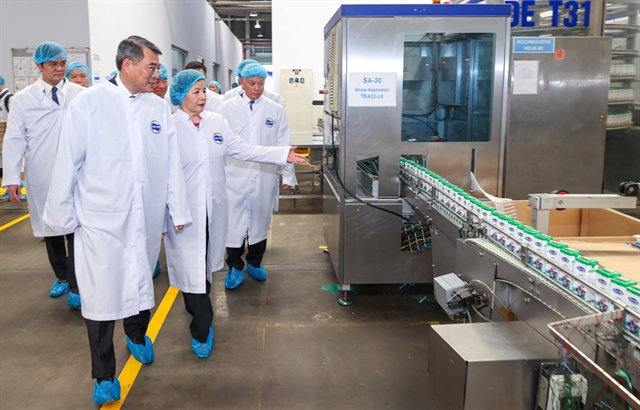 |
| Prime Minister Lê Minh Hưng visited the Angkor Milk project of Vietnam Dairy Products Joint Stock Company (Vinamilk) in October. Photo chinhphu.vn |
CLMV’s trade and investment cooperation now is supported by bilateral and multilateral mechanisms.
At the 17th CLMV Economic Ministers’ Meeting in Yangon, Myanmar, in November 2025, ministers highlighted the need to strengthen economic integration, facilitate trade and investment, improve logistics and connectivity, and develop human resources.
The meeting’s joint statement recognised the importance of trade fairs organised by Việt Nam in strengthening trade and investment links among CLMV countries.
At the bilateral level, Việt Nam and Laos have identified trade, energy and infrastructure connectivity as priority areas. Cambodia and Việt Nam are seeking to improve logistics and border trade to support their $20 billion trade target, while cooperation with Myanmar needs to take account of the market conditions and business risks.
Despite having many opportunities, Vietnamese businesses continue to face challenges related to institutional differences, administrative procedures, logistics infrastructure, technical standards, payment systems and policy implementation.
As CLMV countries deepen integration across the Mekong subregion, the priority will be to turn policy commitments into projects that generate tangible economic value. Better logistics, infrastructure links, border trade and cross-border supply chains will be essential.
With its geographical position, production capacity and growing international investment experience, Việt Nam is well-placed to expand its role in the CLMV trade and investment network, helping build more sustainable economic links with Cambodia, Laos and Myanmar. VNS