 |
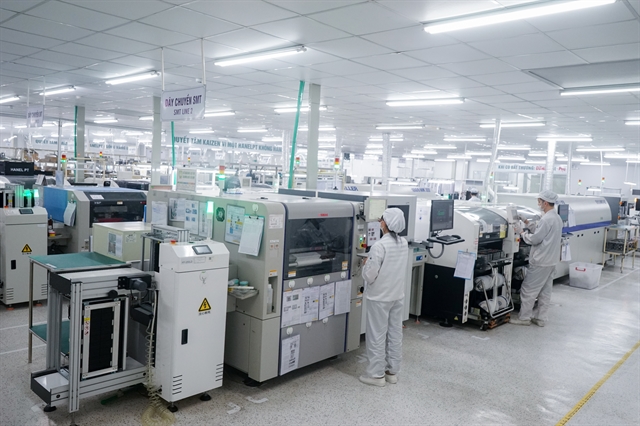
| A production line of Hanel Production and Import-Export Joint Stock Company (Hanel PT). The company has successfully participated in global supply chains. — VNA/VNS Photo |
Compiled by Thu Hà
HÀ NỘI — While Việt Nam has no shortage of opportunities to take part in global supply chains, limited capability of both the economy and businesses is the biggest challenge hindering the participation, experts said.
Although Việt Nam has become an attractive destination for global foreign direct investment (FDI), most Vietnamese businesses have remained outside global supply chains or only take part in the lowest value-added stages.
According to Dr Nguyễn Anh Tuấn, chairman of the Vietnam Association of Foreign Invested Enterprises (VAFIE), the connection between the FDI sector and Vietnamese businesses is very limited.
He says some even say there are two economies in Việt Nam. One is an FDI economy with very high productivity, very large exports, and modern technology and the other is a domestic economy that lags behind and cannot participate in the connection.
The thought-provoking figures presented by Dr Lê Duy Bình, director of Economica Vietnam, also clearly reflect the actual position of Vietnamese businesses in the global supply chains.
Bình cited data showing that Việt Nam has over one million active businesses, but only about 5,000 participate in global supply chains. Of these, only over 300 are suppliers to multinational corporations, and only over 100 have become Tier 1 suppliers.
Up to 64.7 per cent of businesses are not yet prepared in terms of technology and processes to meet international standards. Even more concerning is that the data was released two years ago. It shows a very slow pace of improvement in both the number and quality of Vietnamese businesses participating in global supply chains.
According to Bình, the majority of Vietnamese businesses are still concentrated in the processing and assembly stages – the lowest value-added segment in the ‘smile curve’ of the global value chain.
“We haven’t yet reached higher value-added areas like ideas, research and development, branding, and design,” Bình said.
“Even in industries like fashion and textiles, we are still mainly engaged in outsourcing.”
This means that, despite strong export growth, the value retained by Vietnamese businesses remains limited. The majority of profits, technology and control over the supply chain are still in the hands of foreign corporations.
Experts believe that the biggest obstacle hindering Vietnamese companies to participate in the global supply chain is the limited capacity of the economy and businesses.
Bình cited data showing that Việt Nam’s labour productivity remains low, only about 25 per cent of Malaysia’s and about 50 per cent of Thailand’s. Approximately 60-70 per cent of Vietnamese businesses are using average or outdated technology, limiting their ability to meet international standards.
In addition, nearly 80 per cent of the Vietnamese workforce lacks professional qualifications or certifications.
Businesses also spend very little on research and development (R&D), less than 1 per cent of revenue, much lower than the average of 3-5 per cent in economies of similar size.
“These factors explain why Vietnamese businesses struggle to achieve the capabilities sought by global giants,” Bình said.
Practical experience
From the perspective of a business that has successfully participated in global supply chains, Trần Đức Tùng, deputy general director of the Hanel Production and Import-Export Joint Stock Company (Hanel PT), and general secretary of the Bắc Ninh Provincial Industrial Production Association, shared that FDI enterprises usually select suppliers through a three-step process: searching, screening and evaluating.
Tùng said that to participate in the global supply chain, businesses must proactively appear through industry associations, specialised exhibitions, supply-demand connection platforms or partner networks. This is followed by a series of rigorous evaluation rounds such as factory audits, quality assessments, cost evaluations, delivery schedules and improvement capabilities.
Notably, Tùng noted, the criteria for selecting suppliers have changed significantly. Low price is no longer the sole determining factor. FDI corporations are increasingly paying comprehensive attention to collaborative culture, level of commitment, governance systems, sustainable development orientation (ESG), and innovation capabilities.
This indicates that competition in the global supply chain is shifting from cost competition to competition based on trust, transparency, and long-term value.
Based on practical experience, Tùng proposes a three-tiered business development model: the value tier (building corporate culture and ESG commitment); the system tier (digital transformation, transparent governance, green production); and the capability tier (quality, cost, delivery, and innovation).
This is considered a fundamental roadmap for Vietnamese supporting industry enterprises to upgrade and participate more deeply in the global supply chain.
“Vietnamese businesses cannot wait to be chosen in global supply chains,” Tùng said.
“They must proactively appear, be transparent and be ready to be evaluated according to international standards.”
According to Tuấn of VAFIE, small and medium-sized enterprises (SMEs) currently face significant difficulties in terms of capital and technology. Without government support policies, this situation will continue.
Tuấn likened the challenge of participating in global supply chains to the ‘chicken and egg’ dilemma: domestic businesses wanting to invest in machinery and innovate technology to meet FDI requirements need capital, but to borrow capital, they must prove they have already participated in the supply chain.
Meanwhile, he said, an uncompleted legal system, overlapping administrative procedures, and insufficient supporting industrial policies are also becoming obstacles to the upgrading of domestic companies.
Tuấn believes that Việt Nam needs stronger policies to promote linkages between FDI and domestic businesses, while increasing the localisation rate in production.
“Comprehensive preferential policies on taxes, land, human resource training, and research and development support are needed to encourage large corporations to support Vietnamese SMEs in improving their technological level,” Tuấn said. — BIZHUB/VNS