
 |
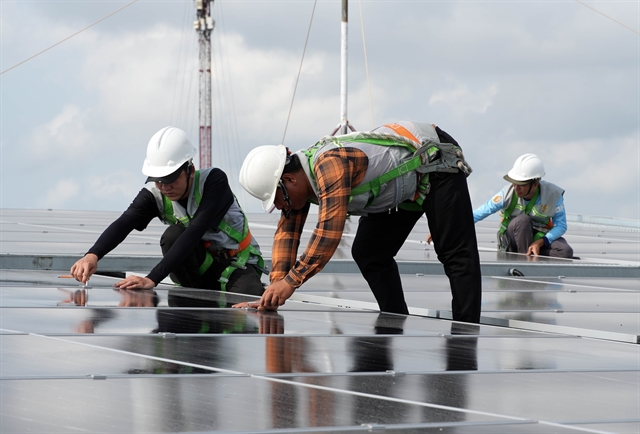
| Workers install solar panels in Cà Mau Province. The Ministry of Industry and Trade plans to submit a revised Law on Electricity to the National Assembly in October. — VNA/VNS Photo Trung Hiếu |
HÀ NỘI — The Ministry of Industry and Trade plans to submit a revised Law on Electricity to the National Assembly at its October session, aiming to remove investment barriers and facilitate mobilisation of resources for power generation and grid development, said Deputy Minister Trương Thanh Hoài.
Speaking at the Government’s regular September press briefing on October 3, Hoài said that Việt Nam’s electricity demand is currently rising by about 10 per cent annually, while developing power generation and grid projects requires considerable time.
According to Vietnam Electricity (EVN), the total installed rooftop solar capacity nationwide has reached about 11,000MWp.
The Government and the ministry have set a target of having about 10 per cent of public offices and 10 per cent of households nationwide install and use such systems each year, she said.
Under the eighth power development plan, the ministry has allocated rooftop solar development targets to each locality. It has also held online conferences and asked provincial and municipal People’s Committees to step up measures to promote development, including issuing support policies within their authority. Several localities have already introduced such policies, and the ministry will continue urging others to do so.
To ensure the 2030 targets, the ministry is focusing on two main areas. First, it will review and amend the Law on Electricity to improve the legal framework. Second, it will review and adjust the eighth power development plan, replacing and updating delayed power projects in line with National Assembly resolutions and directions from the Prime Minister.
Alongside expanding supply, Hoài stressed the need to step up electricity-saving measures under the Law on Economical and Efficient Use of Energy, helping meet annual electricity demand growth of about 10 per cent and support economic development.
Also at the press briefing, Deputy Governor of the State Bank of Vietnam Phạm Thanh Hà addressed credit management to meet capital needs for growth while ensuring system safety and controlling inflation.
As of September 30, total outstanding loans of the credit institution system stood at about VNĐ20.75 quadrillion (US$799 billion), up 11.59 per cent from the end of last year and 16.69 pẻ cent year-on-year, in line with the bank’s target for the year, he said.
Highlighting a number of solutions to create room for credit institutions to provide loans to priority sectors and key economic projects, supporting growth, the Deputy Governor said the banking sector will strengthen preferential-interest credit programmes for economic growth drivers and small and medium-sized enterprises, as well as lending for agriculture, forestry and fisheries; production, processing and consumption chains for high-quality, low-emission rice in the Mekong Delta; social housing; and infrastructure projects in electricity, transport and strategic technologies.
In addition to commercial credit provided by credit institutions and commercial banks, the central bank will continue directing and supporting the Vietnam Bank for Social Policies in expanding policy-based lending to beneficiaries of national target programmes in line with the Government’s directions. — VNA/VNS