
Iran’s Foreign Minister Abbas Araghchi announced Friday that the Strait of Hormuz is “completely open” to commercial shipping for the remainder of the US-Iran ceasefire, a declaration that drew an immediate public thank-you from President Trump.
“In line with the ceasefire in Lebanon, the passage for all commercial vessels through Strait of Hormuz is declared completely open for the remaining period of ceasefire, on the coordinated route as already announced by Ports and Maritime Organisation of the Islamic Rep. of Iran,” Araghchi wrote on X.
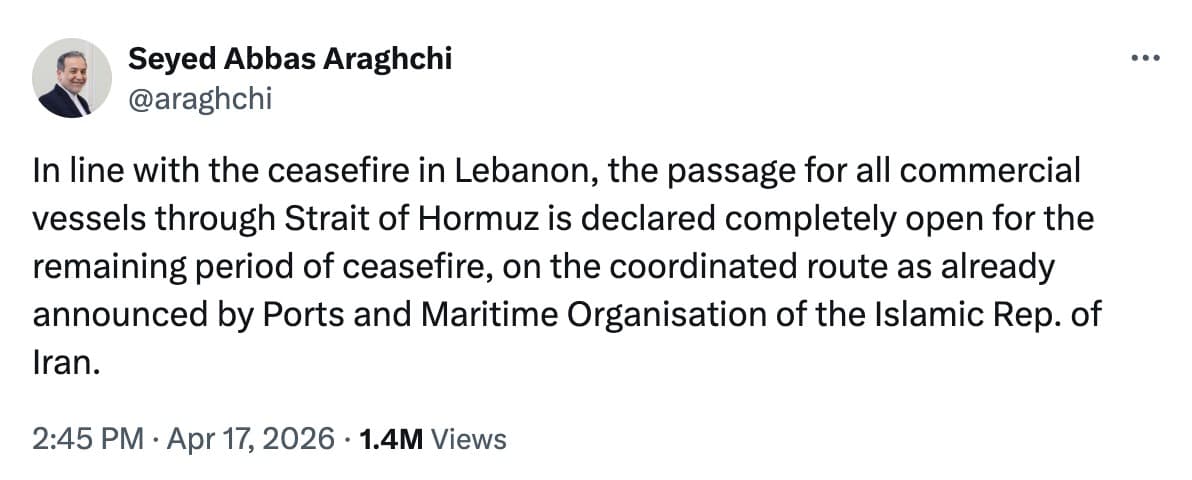
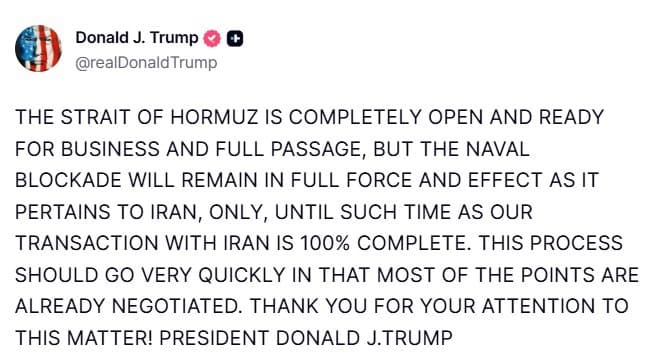
Trump responded on Truth Social with two posts. The first was brief, simply stating that the Strait was open…
A second post spelled out what that actually means for the blockade, stating that the United States’ naval blockade on Iranian ports will remain in effect until a deal is reached…
The announcement came on the same day a 10-day ceasefire between Israel and Lebanon took effect, with Lebanese President Joseph Aoun calling direct negotiations with Israel “delicate and crucial.”
Addressing lawmakers, Aoun called for Israeli withdrawal, the release of prisoners, and resolution of border disputes, framing the ceasefire as the gateway to further talks.
The Hormuz opening, if it holds, would mark a significant moment in a crisis that has rattled global energy markets since Feb. 28, when the United States and Israel launched airstrikes against Iran.
Tehran responded by closing the strait — through which roughly 20% of the world’s daily oil supply normally flows — and launching missile and drone strikes against Israel and US military bases. Major shipping firms including Maersk, CMA CGM, and Hapag-Lloyd suspended transits almost immediately.
What the reopening means in practice is still unclear.
Araghchi’s statement specifies a “coordinated route” — and Iran’s history of controlling traffic at its own discretion throughout the ceasefire period gives little ground for certainty.
The US naval blockade on Iranian ports also remains in effect. The Trump administration imposed the blockade after Iran-US talks collapsed in Islamabad earlier this month, targeting ships entering or leaving Iranian ports and coastal areas while…in theory…preserving freedom of navigation for vessels transiting to non-Iranian ports.
There is at least one concrete sign of movement.
A Pakistan-flagged Aframax tanker, the Shalamar, became the first vessel to clear the Hormuz with crude since the blockade began Monday, according to ship-tracking data compiled by Bloomberg.
The tanker loaded around 450,000 barrels at Das Island in the UAE, not an Iranian port, and is now in the Gulf of Oman en route to Karachi. It had abandoned an earlier attempt to transit inbound on April 12 when news broke that the Islamabad talks had collapsed. The Shalamar aside, maritime intelligence firm Windward reported 823 vessels present across the Gulf as of Tuesday with no corresponding release into normal transit patterns.
Britain and France are holding a virtual summit Friday on restoring freedom of navigation through the waterway, with mine clearance a particular concern. US Central Command has already begun mine-clearing operations inside the strait, though Iran at one point accused the US of a ceasefire violation for doing so.
The economic stakes are considerable.
Goldman Sachs warned that Brent crude prices are set to average above $100 per barrel this year if the strait remains mostly shut for another month. Wood Mackenzie estimated that $100 Brent would slow global economic growth to 1.7%, down from a pre-war forecast of 2.5%, with global recession possible at $200 oil.
Pakistan continues to shuttle between Washington and Tehran in an effort to broker a permanent peace deal.
Whether today’s Hormuz announcement represents a genuine pivot or another temporary measure will depend, as analysts have consistently noted, not on declarations…but on ships actually moving through.
By Michael Kern for Oilprice.com