
The technical pullback is also unfolding against a less favorable macro backdrop. Warsh emphasized that inflation remains above the Federal Reserve’s target and signaled little urgency to move toward easier monetary policy, putting renewed pressure on precious metals.
Silver’s Move Above $72 Turns Into a Bull Trap
LBoard’s analysis begins with what happened around $72.
But the breakout did not hold.
Importantly, he doesn’t believe the reversal necessarily invalidates the broader bullish structure.
His chart shows silver previously breaking out from a declining channel or bull-flag structure that had developed after the major advance toward the $100 area earlier this year. Instead of immediately accelerating higher after that breakout, silver is now coming back toward the breakout zone.
The key question is whether buyers return during that retest.
Why $62.70 Could Be Silver’s Next Important Level
LBoard believes the correction may not be finished yet.
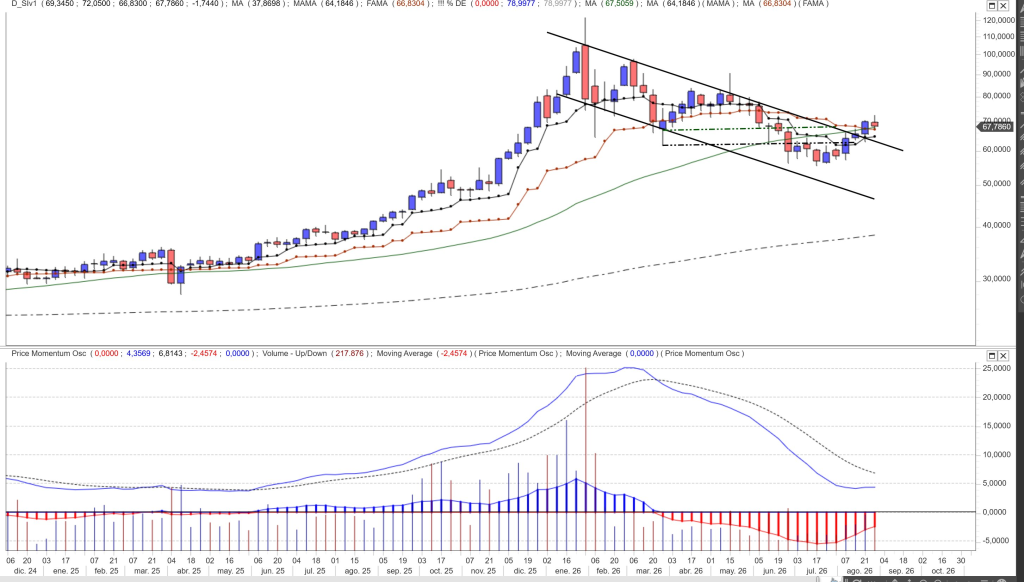
That area is particularly important because it sits around the previous breakout structure and close to the lower portion of the recent consolidation.
In other words, silver doesn’t necessarily need to rebound immediately for LBoard’s bullish thesis to survive.
A drop toward $62.70 followed by strong buying could actually strengthen the breakout-and-retest interpretation. Silver would have returned to an important technical area, tested whether former resistance can become support, and potentially established a base for another advance.
The bearish scenario would become more concerning if silver falls through this region and fails to recover it. That would make the recent breakout look considerably less convincing.
His sequence is straightforward: first the backtest, then—provided support holds—the larger bullish move.
Read also: Silver Price at a Bitcoin (BTC) 2015 Moment? Analyst Explains Why It Could Rise 10x
Warsh’s Jackson Hole Speech Accelerates the Silver Selloff
While the chart may have already been vulnerable to a correction, the catalyst that accelerated it came from Jackson Hole.
Recent inflation readings have improved in some areas, but Warsh did not present them as sufficient evidence that underlying inflationary pressures have been defeated. He also highlighted rising commodity prices as something policymakers need to monitor.
That matters directly for silver and gold because expectations surrounding Federal Reserve policy influence the opportunity cost of holding non-yielding precious metals.
If inflation remains stubborn while the economy remains resilient, the Fed has less reason to quickly loosen monetary policy. Expectations for higher-for-longer interest rates can support Treasury yields and the U.S. dollar, creating a more difficult environment for precious metals.
A Strong Economy Gives the Fed Less Reason to Ease
Warsh also pushed back against the idea that softer employment data necessarily means the U.S. economy is deteriorating rapidly.
Business investment remains strong, AI-related capital expenditure continues to expand, consumer spending remains healthy, and unemployment is still historically low.
Those conditions create another problem for traders hoping for rapid monetary easing.
If economic activity remains resilient while inflation stays above target, the Federal Reserve can afford to remain restrictive for longer. Silver therefore faces a tug-of-war between its longer-term bullish technical structure and a near-term macro environment that has suddenly become less supportive.
This distinction also helps explain LBoard’s argument.
Silver Price Prediction: Correction First, Rally Later?
The chart leaves silver at an interesting point.
But the larger structure hasn’t necessarily broken.
Silver appears to be testing the upper boundary of the descending structure it recently escaped. If the $62.70-$65 region ultimately holds and price begins forming higher lows, the current selloff could end up looking more like a conventional breakout retest than the beginning of a new major downtrend.
Momentum also deserves attention. The lower panel of LBoard’s chart remains negative, but the negative bars have begun contracting from their recent extreme. That indicates bearish momentum has started to ease, although it has not yet produced a decisive bullish confirmation.
If it does, silver could rebuild toward $70-$72 and eventually make another attempt at a larger breakout. If $62.70 fails decisively, however, the bullish interpretation would become considerably harder to defend.