
HCM CITY — Việt Nam’s growth story remains intact, but the drivers of expansion are shifting, with domestic investment, infrastructure development, institutional reform and capital-market deepening becoming increasingly important growth engines, according to SSI Research.
In its strategy report for the second half of 2026, SSI Research projected Việt Nam’s real GDP growth at 8.2-8.5 per cent year-on-year in the second quarter, with potential upside towards 9 per cent if June data proves stronger. The forecast would mark an acceleration from the 7.83 per cent growth recorded in the first quarter.
The brokerage said growth is increasingly being driven by sustained realised foreign direct investment (FDI) inflows and a public investment programme expected to gain momentum in the second half of the year.
A meaningful improvement in banking system liquidity is unlikely in the coming months, while interest rates are expected to remain higher for longer. As these pressures are largely domestically driven, even a potential interest-rate cut by the US Federal Reserve later this year may provide only limited relief. Foreign-exchange pressures, however, are expected to ease relative to 2025 levels.
SSI Research also noted that headline GDP figures may understate underlying productivity gains. Faster project approvals, improved governance, expanded digital public services and lower transaction costs are helping to strengthen Việt Nam’s structural growth capacity and improve economic efficiency.
“We maintain that growth momentum remains intact, with activity expected to accelerate in the second half of 2026 to meet our full-year projection of around 9 per cent, which implies H2 growth near 10 per cent as realised FDI and public investment reach their peak levels,” the report said.
The brokerage cautioned that risks remain, including a widening trade deficit, potential changes in US Section 301 trade policy and inflation remaining close to policy ceilings. However, stronger public infrastructure spending and a recovery in property development activity are viewed as part of the baseline growth trajectory rather than unexpected upside surprises.
SSI Research said the widening trade deficit should not necessarily be viewed as a sign of weakness, but rather as evidence of an economy importing capital goods and raw materials to expand productive capacity.
The report noted that policymakers are increasingly focused on building long-term growth drivers through infrastructure investment, housing development, state-owned enterprise (SOE) reform, administrative simplification and capital-market development.
This shift is particularly evident in financial markets. Việt Nam’s market-upgrade story is evolving beyond FTSE Russell and MSCI classification decisions towards improving overall market investability through higher free-float ratios, SOE divestment, stronger governance, better investor protection and deeper capital markets.
At the same time, infrastructure reforms, public-private partnership restructuring, fiscal discipline, legal execution improvements and efforts to resolve long-standing project bottlenecks are strengthening the country’s ability to attract long-term capital. Sovereign credit ratings, like equity market classifications, are ultimately outcomes rather than objectives. The objective is to create an economy that global investors can deploy capital into with confidence, according to the report.
2H26 market outlook
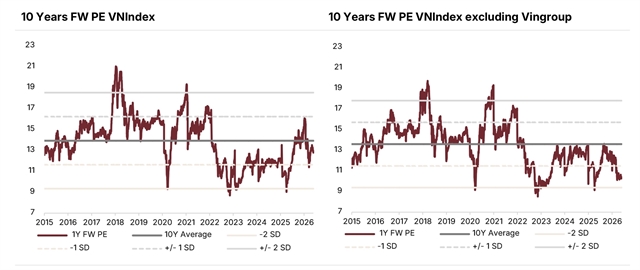 |
| The VN-Index is currently trading at a forward price-to-earnings ratio of around 13 times. — Source SSI Research |
SSI Research maintained its base-case VN-Index target of 1,920 points and a best-case scenario of 2,120 points.
The firm expects the market to undergo a consolidation phase in the coming months before regaining momentum towards year-end. A move to higher index levels is better viewed as a medium-term scenario extending into 2027, contingent on a more meaningful easing in domestic monetary conditions and a sustained recovery in foreign inflows, particularly those associated with the market-upgrade cycle.
Several factors are expected to support the market in the second half of 2026. Public investment disbursement is likely to accelerate from a relatively low first-half base, providing a boost to economic activity and investor sentiment. Meanwhile, moderating oil prices should help ease inflation concerns.
Equities are also expected to remain attractive relative to alternative assets. Although a gradual rise in deposit rates may enhance the appeal of bank savings, a slowdown in alternative asset classes, notably real estate and gold, should help sustain equities’ relative attractiveness in household and institutional portfolios.
Valuations also remain supportive. The VN-Index is currently trading at a forward price-to-earnings ratio of around 13 times, broadly in line with its five-year average. Excluding Vingroup-related stocks, the market trades at approximately 10.3 times forward earnings, suggesting attractive opportunities remain across a range of sectors.
The brokerage expects construction materials and consumer-related sectors to deliver the strongest earnings growth in 2026, supported by infrastructure spending and industry consolidation. Financials are also expected to maintain steady growth on the back of healthy credit demand.
Aggregate net profit after tax attributable to minority interests (NPATMI) is forecast to grow by 20.9 per cent excluding Vingroup and 24.8 per cent including the conglomerate. — VNS