
Key Takeaways:
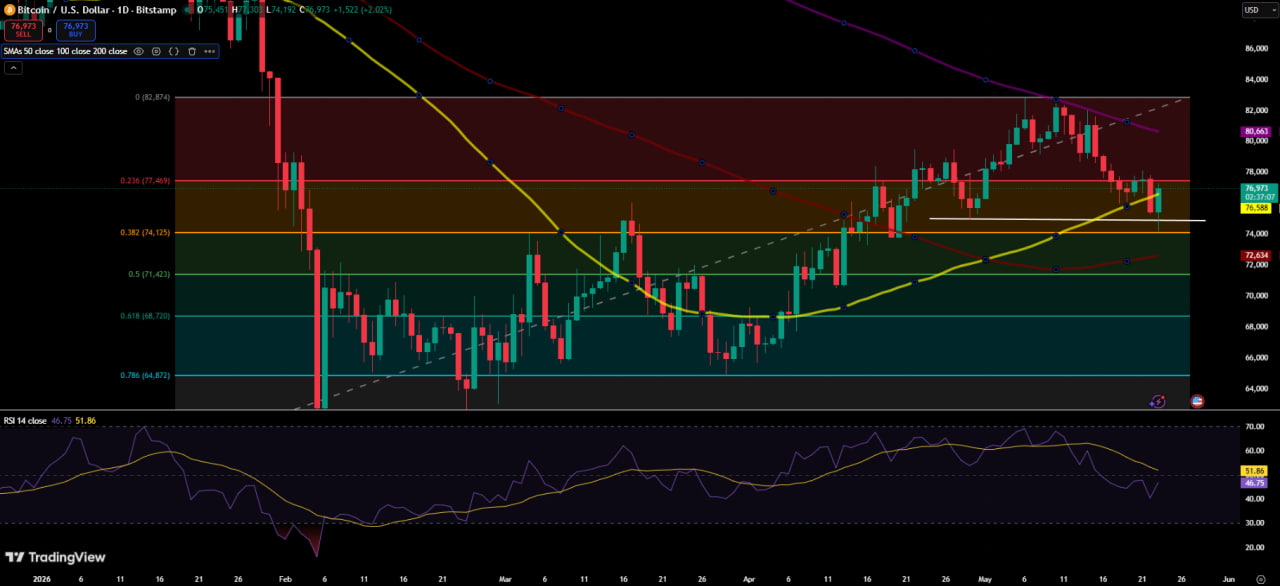
- Bitcoin is trading around $77,000, rejected sharply from the 200-day moving average at $82,000-$83,000.
- Spot ETFs recorded $2.26 billion in net outflows over two weeks, signaling fading institutional appetite.
- Perpetual swap funding rates have been negative for 81 consecutive days – traders are unusually bearish even at these price levels.
- On-chain data shows sellers historically exhaust themselves at $60,000, where 10.6 million BTC enters net loss territory.
Bitcoin has been grinding sideways between $75,000 and $80,000 for weeks, pinned below the 200-day moving average at $82,000-$83,000 – the zone where a large portion of institutional ETF buyers are sitting at breakeven and where selling pressure reliably kicks in. The asset shed roughly 40% from its October 2025 peak of $126,000 before finding a floor at $60,000 in early February 2026. Since then, the rebound has been slow, unconvincing, and twice rejected at the same ceiling. The question now dividing traders, analysts, and institutions is straightforward but unanswerable with certainty: was $60,000 the definitive cycle bottom, or is the market building toward one final capitulation?
The Unfinished Business at $60,000
There is also a performance gap worth noting. The Nasdaq has climbed roughly 30% from its March lows, yet Bitcoin has lagged well behind. Historically, when the tech index posts that kind of run, crypto tends to double or triple the move, with altcoins doing even more. None of that has materialized, and the underperformance is a data point that bears watching.
READ MORE:
Home Buyers Can Now Use Bitcoin as a Down Payment in US: Here Is How It Works
Why the Old Rules No Longer Apply
The counter-argument rests on data that is harder to dismiss. On May 19, K33 Research published an analysis in which Vetle Lunde documented 81 consecutive days of negative perpetual swap funding rates on Bitcoin – close to an all-time record. Put plainly, traders have been betting against Bitcoin for nearly three months straight, even with prices nowhere near the lows. This is structurally unusual. In typical bear cycles, the shorts get flushed out well before any real bottom forms and the market falls without a cushion underneath. Here, any move back toward $60,000 would trigger a wave of forced short covering that mechanically slows the descent and limits how far price can fall.
K33 nonetheless puts their base case firmly on the other side of that argument. The firm views February’s $60,000 low as the maximum drawdown for this cycle, with Vetle Lunde, the company’s head of research, noting that “the less aggressive bull market of 2025 sets the stage for a more moderate bear market in 2026” – meaning the damage is already done, and what follows is recovery, not another leg down.
At both of the previous major cycle bottoms – February 2019 and January 2022 – selling activity dried up at precisely the point where 10.6 million circulating Bitcoin were sitting at a net loss. When Bitcoin touched $60,000 on February 5, 2026, that figure stood at 9.93 million BTC. If price returns to $60,000 now, the math brings that number right up to the historical exhaustion threshold – the level where sellers have consistently stopped selling.
Where Things Stand
The technical rejection at $82,000-$83,000, the ETF outflows, and the Nasdaq divergence all point to a market that has not finished digesting the damage from the October peak. At the same time, 81 days of negative funding rates and a historically reliable on-chain exhaustion metric at $60,000 suggest the floor is not as fragile as it looks. The next meaningful move – whether that is a confirmed break above $84,000 toward $97,000 or a retest of February’s low – will answer the question better than any analyst currently can. Until then, the $60,000 level stays on the map.
The information provided in this article is for educational purposes only and does not constitute financial, investment, or trading advice. Coindoo.com does not endorse or recommend any specific investment strategy or cryptocurrency. Always conduct your own research and consult with a licensed financial advisor before making any investment decisions.